The Sync Alliance: Joshua Williams' $55 Skool
The Sync Alliance is Joshua Williams' Skool community for sync licensing, 136 members at $55 a month with eight admins and live music supervisor feedback.
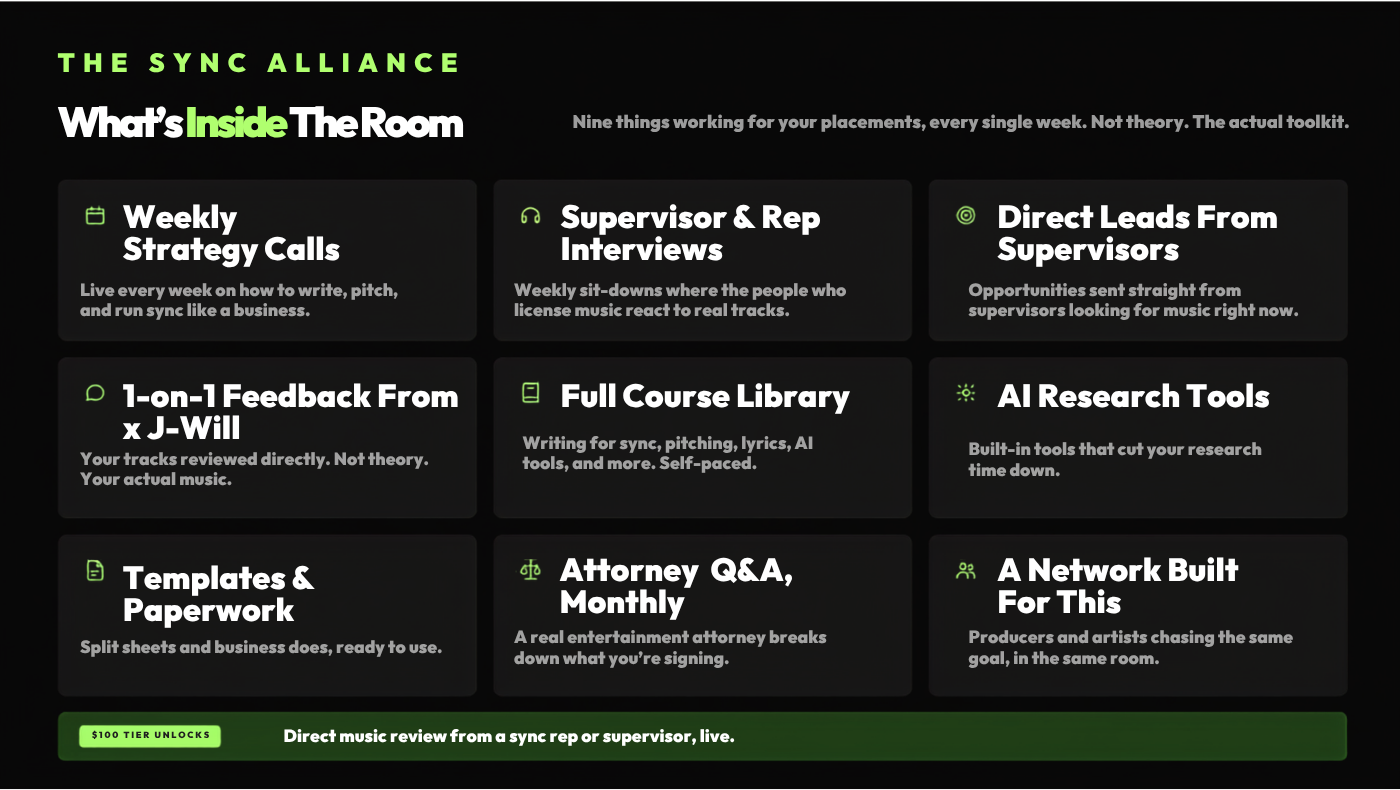
The Sync Alliance is Joshua Williams' private Skool community for musicians chasing TV, film and advertising placements, with 136 members at $55 per month and eight admins. It sits at rank 14 in the Skool Games Music top 50 and rank 953 on Skool's public global board. Almost every other room in that Music top 50 sells a skill. This one sells a person: the music supervisor who decides which track gets used.
The numbers
- Music niche (sync licensing for TV, film and advertising)
- Rank 14 in the Skool Games Music top 50, 953 globally
- 136 members, private
- $55/mo, no trial shown
- 8 admins, roughly one per 17 members
- 6,732 posts since May 2024
- 5.0 from 2 Skool reviews, too few to mean much
- Stated roadmap: first TV or film placement in 90 days
Who is Joshua Williams?
Joshua Williams is the founder of The Sync Alliance and runs it on Skool as @joshua-williams-4163. His Skool profile lists Kansas City and an account opened in February 2024, and the community itself was created in May 2024. The about page does not print a personal credit list, which is itself the choice worth noticing: the proof on the page belongs to the members and the supervisors, not to the founder.

How The Sync Alliance sells
It sells the buyer, not the craft. The first line assumes you can already play, then reframes every year you spent getting good as an asset currently earning nothing, and the fix it offers is not another course but weekly contact with the people who license music.
That is a different product from everything around it on the board. A guitar room sells you a technique you did not have. A mastering room sells you a finish you could not get. This room assumes the recording is fine and says the missing piece is distribution to a buyer with a budget, which is the one bottleneck a tutorial cannot clear.
The opening sentence does the qualifying. "You put in all these years getting great at music" politely excludes beginners without ever saying the word, and it flatters exactly the person who is most frustrated: competent, unpaid, and starting to wonder whether the competence was wasted.
What the about page actually says
The whole Sync Alliance about page is reproduced below, unedited apart from emoji. Five lines are annotated; hover a number for why that line is there.
1Members inside this community have landed Netflix, Toyota commercials, ESPN, and the Olympics.
2You get the exact system they use, plus the people most musicians never meet: the music supervisors who choose the tracks for Apple, the NFL, Warner Brothers, and Sony projects, giving you feedback on YOUR music live.
Inside you'll get:
Weekly access to supervisors actively searching for music to use
Live feedback on why your music isn't landing yet
3A 90-day roadmap to your first TV or film placement
Real briefs and templates so you never guess what to submit
4Monthly time with our House Attorney to help cover the business side
Every month without this system is another month your music sits unheard by the people who pay for it.
Your years in music were the training. Join now. This is the payoff.
5Make Music for Brands, Not Fans (TM) (it pays WAY more)
The most interesting line on the page is the lawyer
Monthly time with a House Attorney is the least exciting bullet on that page and the one worth copying. Sync is a rights business. A musician who lands interest from a supervisor immediately meets a contract, a term, a territory and a question about whether they actually control both sides of their own song, and that is where the excitement usually dies.
Most communities in a creative category sell the dream harder as the price goes up. This one spends a deliverable on the objection instead. It is the same instinct behind a health community selling a lab review rather than more motivation: name the thing that stops people after they succeed at the first step, then put it inside the membership.
There is a second effect. Offering legal time signals that placements happen here often enough to need it. You do not staff a contracts clinic for a room where nobody gets an offer, so the bullet functions as proof without making a claim, which is a quieter and more durable form of evidence than a testimonial.
Staff the objection, not the dream: find the moment where your members succeed and then get stuck, and make clearing that moment a named deliverable. It converts better than more inspiration, and it implies your members reach that moment often enough for you to have built for it.
Access is a different business from teaching
Set The Sync Alliance beside the other Music rooms we have broken down and the split is clean. Most of them sell capability. This one sells introductions, and that changes the economics of the room.
| Music community | What is actually sold | Price | Members |
|---|---|---|---|
| The Sync Alliance | Access to music supervisors and briefs | $55/mo | 136 |
| Mastering.com Members Club | A finishing skill, at library scale | $29/mo | 37,025 |
| Marthyn's Drum Camp | A measurable technique outcome in BPM | $49/mo | 378 |
| Chase's Guitar Academy | A curriculum plus founder feedback | $59 or $79/mo | 212 |
| Louis' Trumpet Academy | A measurable range outcome in notes | $49/mo | 197 |
| Black Suit Music | Readiness and posted opportunities | $15/mo | 549 |
Teaching scales. Access does not. A mastering course can serve 37,025 people because the lesson is identical for everyone who watches it, which is why that room can charge $29 and still hold the largest paid roster we have logged anywhere on the platform. Supervisor attention is a fixed and small quantity, so the more members you admit, the thinner the thing you sold becomes.
That is the honest reading of 136 members at $55. The roster is not small because the room is failing; it is small because the product breaks if it is not. Eight admins against 136 members, roughly one per 17, is the staffing signature of a room that has promised individual attention and knows it. That ties Pocket Singers Elite at 153 members and nine admins for the richest staffing we have logged in Music, ahead of the one per 22 we recorded at Louis' Trumpet Academy. Neither is a corpus record: a ballet certification elsewhere on Skool runs roughly one admin per eight.
What the public board says
Skool's own leaderboard puts The Sync Alliance at rank 14 in Music and 953 globally, with around 960 visitors in the window we pulled. The 30-day recurring revenue change was negative at the time of the pull, while the doors were open and the join button was live.
That combination is worth reading carefully rather than dramatically. A small, high-attention room with no free trial and no entry tier has very little cushion: a handful of cancellations in a 136-member roster moves the number, and one month of direction is not a trend. It is also the exact profile where a single quarter of placements can reverse it, because the members who do land a Netflix or an ESPN cue have a concrete reason to stay and a story that recruits.
Nothing sits in front of the $55 button. Everything rests on the about page persuading a stranger to pay before seeing anything, which puts unusual weight on those four brand names in line two. See how to rank on Skool Discovery for how the traffic reaches a page like this one in the first place.
The funnel, step by step
Musicians arrive from sync licensing searches and from Skool Discovery, pay $55 with no trial in between, and land in a room whose central event is a supervisor reacting to their track in front of them.
The room has posted 6,732 times since May 2024. Against 136 current members that is roughly 49 posts each, one of the densest ratios we have recorded. The caveat is structural rather than optional: the numerator counts every post ever made and the denominator counts only the people currently in the room, so age inflates it and departures inflate it further.
The formula you can copy
Sell the bottleneck, not the subject. If your members already have the skill and still have no money, the product is not another module, and saying so out loud is what makes a $55 page sound like relief rather than another course. The rule generalises well beyond music, as how to write a Skool about page sets out.
Put a clock on an open-ended fee. A ninety-day roadmap turns a subscription into roughly three payments for a named milestone. That is the same move a $900 video community makes when it promises professional work in six weeks, and it is why pricing a Skool community is easier once you can name what finishes.
Then price for the ceiling you actually have. Access does not scale, so a room built on it stays small and has to charge accordingly, while a room built on a repeatable lesson can go the other way entirely, as Mastering.com's 37,000-member club does at $29.
Frequently asked questions
What is The Sync Alliance on Skool?
The Sync Alliance is a private Skool community founded by Joshua Williams for musicians pursuing sync licensing placements in TV, film and advertising. It has 136 members, eight admins and 6,732 posts, and costs $55 per month. The about page describes weekly access to working music supervisors, live feedback on members' tracks, real briefs and templates, a ninety-day roadmap to a first placement and monthly time with an in-house attorney.
How much does The Sync Alliance cost?
Fifty-five dollars a month, charged from the first day. The about page shows no free trial, no feeder community and no lower tier, so the full price is the entry point. Skool bills the subscription and the community owner sets and administers any refunds, which are not mentioned on this page.
What is sync licensing?
Sync licensing, short for synchronisation licensing, is the permission a filmmaker, broadcaster, game studio or advertiser buys to pair a piece of recorded music with moving images. In practice it involves two separate rights: the composition, controlled by the songwriter and publisher, and the recording, controlled by whoever owns the master. A user normally needs clearance on both, which is why independent artists who wrote and recorded their own track are attractive to music supervisors.
How do you get a sync license for your music?
Music is usually placed through one of four routes. You can upload to a production music library or catalogue platform, sign with a sync agent or publisher who pitches on your behalf, pitch supervisors directly against briefs, or work through a network that puts you in front of supervisors. Each trades control for reach: libraries are easy to enter and crowded, agents bring relationships and take a share, and direct pitching pays the most but only works if you can reach the right person with the right cue at the right time.
Do you need to own both the master and the publishing rights?
Not always, but you do need to be able to clear both. If somebody else controls your master, or a co-writer controls part of the composition, the licensee needs permission from them too, and a supervisor working to a deadline will often move on rather than chase a second signature. This is exactly the friction that the community's monthly attorney access is aimed at, and it is worth resolving before you pitch rather than after somebody says yes.
How much does sync licensing pay?
There is no standard rate. Fees vary enormously by use, from small amounts for background cues on independent productions to substantial sums for a national advertising campaign or a prominent placement in a major title, and a large share of the long-term value often comes from performance royalties collected after broadcast rather than from the upfront fee. Anyone quoting you a single number for what sync pays is describing one deal, not the market.
Start your Skool community
Ready to build a community of your own? Start on Skool through our link. We may earn a commission if you create and keep a paid community, at no extra cost to you.
Start your Skool community →Keep reading
Jooba Guitar: Jaco Uys Sells a $10 Room for $3 on Skool

Dave Simpson Guitar World: The $35 Skool Room Reviewed

Clarity Guitar Studio Review: Andre Fludd's $69 Skool
Alex Graf Bluegrass Guitar: Inside the $25 Skool Club

Shredders University Review: Jack Wood's $127 Skool

The Music Licensing Club: Eric Campbell's $9 Skool

Guitar Breakthroughs: Tony Cull's $29 Skool Reviewed

Drumline Accelerator: The $500 Skool for Auditions

Piano Walkers Review: Antonio Romero's $29 Piano Skool