Mastering.com Members Club: 37k Paid Skool Members
Mastering.com Members Club is Rob Mayzes' music production community on Skool, 37,025 members at $29 per month. The largest paid roster we have logged anywhere on the platform, and the arithmetic behind its monthly 1:1 promise.
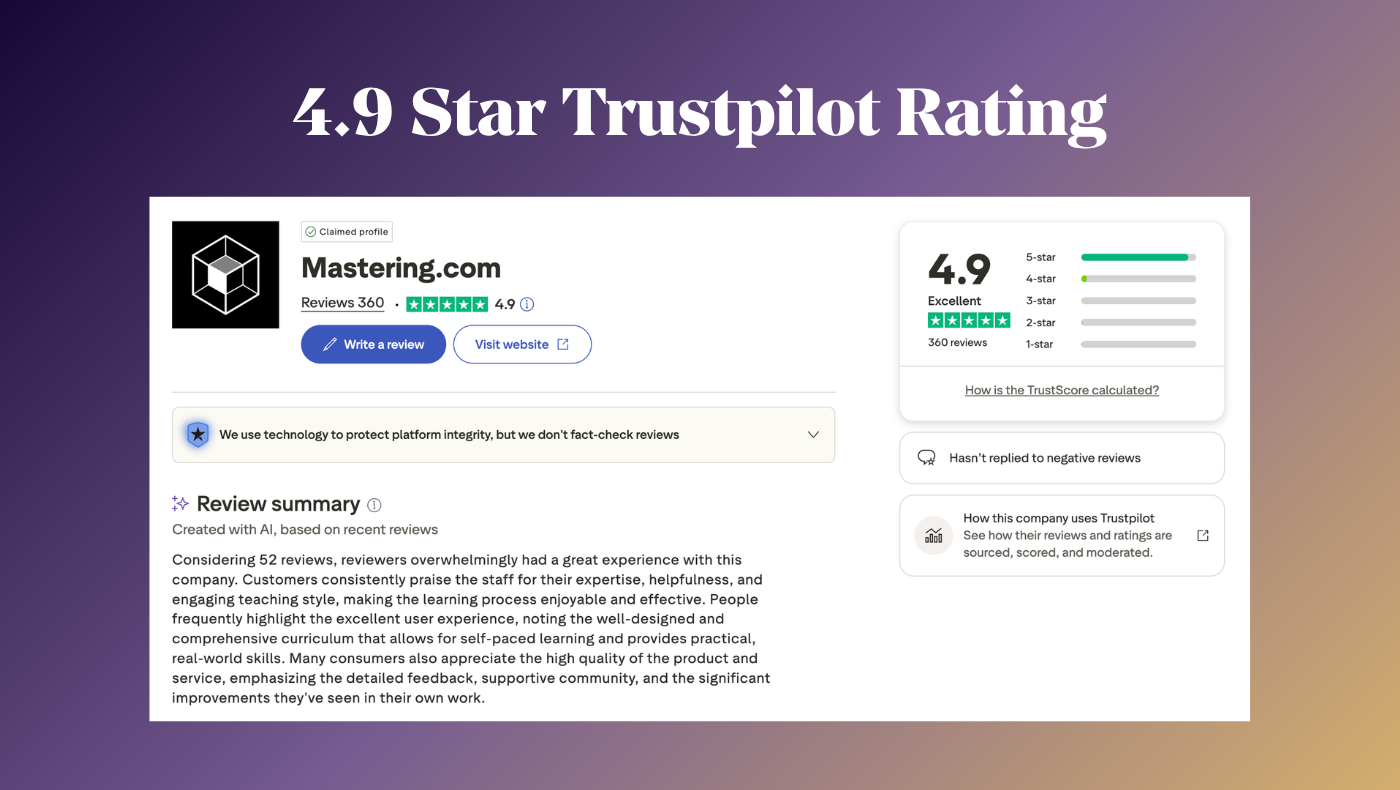
Mastering.com Members Club is Rob Mayzes' private Skool community for music producers and engineers, with 37,025 members at $29 per month and a seven-day free trial. It sits at rank 4 in the Skool Games Music top 50 and carries the largest paid roster we have recorded in any category on Skool. For scale, the other six Music top 10 rooms we broke down the same day hold 61, 190, 378, 396, 402 and 462 members.
The numbers
- Music niche (production, recording, mixing, mastering)
- Rank 4 in the Skool Games Music top 50
- 37,025 members, private, displayed on the page as 37k
- $29/mo with a 7-day free trial
- 16 admins
- 7,263 posts
- On Skool since August 2022
- Claim on the page: largest paid music production community in the world
Who is Rob Mayzes?
Rob Mayzes is a mixing and mastering engineer and educator who runs Mastering.com and posts on Skool as @rob-mayzes. He owns two rooms on the platform: the paid Members Club with 37,025 members, and a free room, Music Production Members Club, that at the time of writing had three members.
How Mastering.com Members Club sells
The page leads with scale, not with a method. The first line is a size claim and the second is social proof, so the reader's first impression is that everyone is already inside. Of the Music top 10 rooms we have broken down, only one other opens on position rather than on a problem, and that is a Spanish-language room that calls itself Club #1.
The offer underneath is a curriculum, not a coaching relationship. Two numbered courses, a 100-hour library, weekly group calls and, sitting inside the list, one monthly fifteen-minute call with a pro. That last item is the interesting one, and the arithmetic behind it is the reason this page is worth studying.
What the about page actually says
Below is the Mastering.com Members Club about page word for word, with the key parts numbered. Hover a number to see what each line is doing.
2Trusted by 36K+ Artists & Producers
Go from random YouTube videos to a clear path producing, recording, mixing and mastering at a pro level - plus 1:1 mentorship every month.
What's Inside
3Music Production 101 - Reach pro quality at home in 6 weeks by learning mastering, mixing and production in reverse ("end in mind" perspective)
Music Production 201 - learn intermediate/advanced audio engineering concepts
4Monthly 1:1 - 15-minute Zoom call with a pro every month to ask questions & get feedback
Guest sessions with Grammy-winners
Weekly Q&A and mentorship calls
5Audio Course Library - Intro to Home Studio, Vocal Intensive, 7-Day Mastering & more (100+ hours)
Sync 101 - get music into TV, ads, films, games
Artist Dev - build your fanbase
Monthly virtual events
Ask questions, get feedback and connect with fellow musicians. All genres and DAWs welcome.
Start a free 7-day trial
The arithmetic behind "1:1 every month"
A fifteen-minute monthly call for every member is the boldest line on the page, so it is worth doing the sum. 37,025 members times fifteen minutes is 555,375 minutes, or about 9,256 hours of calls a month. If all sixteen admins were full time and spent every working hour on these calls, they would cover about 2,560 hours a month.
On those generous assumptions the promise is fully redeemable at a take-up rate of roughly 28 percent. The realistic ceiling is lower, because admin time also goes to the weekly group calls, moderation and content, and we do not know that any of the sixteen are full time. None of this is a criticism. It is how every promise of this shape works, from gym memberships to airline lounges to unlimited support tiers: the offer is priced on redemption, not on capacity.
What is worth copying is the design of the unit. Fifteen minutes is deliberately small: short enough that a member feels reasonable booking it, short enough that a coach can run five in ninety minutes with a gap between each, and short enough that it reads as a real one to one rather than a group call in disguise. A sixty-minute version of the same promise at this roster size would collapse.
Size the unit, not the promise: if you want to advertise individual attention at scale, make the unit small enough that high take-up is survivable and specific enough that low take-up still feels generous. The number of minutes is the whole product decision.
What 37,025 members at $29 actually changes
Scale changes what the community is for. In a 300-member room the founder is the product and the feed is a conversation. At 37,025 members the founder cannot be the product, so the page sells a curriculum with people attached instead: two numbered courses, a hundred hours of library and a rota of sixteen admins.
The engagement figure tells the same story. 7,263 posts across 37,025 members is roughly 0.2 posts per member. Compare that with the densest room we have logged, a 289-member Spanish nutrition community running about 50 posts per member. Neither number is good or bad on its own, but they describe two completely different businesses wearing the same platform.
| Community | Members | Price per month | Cumulative posts per member | What the member is buying |
|---|---|---|---|---|
| Mastering.com Members Club | 37,025 | $29 | ~0.2, since Aug 2022 | A curriculum and a library |
| Marthyn's Drum Camp | 378 | $49 | ~12, since Feb 2022 | A weekly room and a roadmap |
| Grateful Mike's VIP Club | 61 | $260 | not published | Direct access to one teacher |
| 52 Week Guitar Player 3.0 | 396 | ~$200, billed annually | ~35, since Jul 2021 | Accountability and feedback |
Treat that post column carefully. It is lifetime posts divided by today's membership, so an older room scores higher for no other reason than age, and it is a rough proxy rather than a rate. The price column is cleaner: the largest room is the cheapest per member and the smallest is the dearest, though the ordering in between is not tidy, since a 396-member room outprices a 378-member one four times over. More on where these numbers land in how to price a Skool community.
Two tracks that have nothing to do with mixing
Sync 101 and Artist Dev are the retention engine. A member who joins to learn mixing has a natural exit: the day their mixes sound good enough, the subscription stops making sense. Adding "get your music into TV and ads" and "build your fanbase" replaces a finishable goal with an unfinishable one.
This is the same structural move we have logged in other lanes under a different costume, where a community adds a money-making track on top of a skill track. The skill has a finish line. The career does not. For how founders choose that adjacent track, see how to niche down a Skool community.
The funnel, step by step
The formula you can copy
Lead with scale only when the scale is real. A size claim is checkable in one click on Skool, since the member counter sits at the top of every about page. Use it when it wins and never when it does not.
Make individual attention small and specific. Fifteen minutes with a named outcome scales in a way that "book a call anytime" never will.
Add a track that cannot be finished. Skill has a finish line and careers do not, which is why the sync and artist development modules matter more to retention than another mixing course would. For where subscription prices land across the platform, see how much Skool costs.
Frequently asked questions
What is Mastering.com Members Club on Skool?
Mastering.com Members Club is a private paid Skool community for music producers, artists and engineers, run by mixing and mastering engineer Rob Mayzes, with 37,025 members at $29 per month and a seven-day free trial. The about page promises two numbered production courses, a library of more than 100 hours, weekly Q and A calls, guest sessions, monthly virtual events, sync licensing and artist development tracks, and a fifteen-minute one to one call each month.
How much does Mastering.com Members Club cost?
The live join button reads $29 per month after a seven-day free trial. Prices on Skool are set by the community owner and can change, so check the live join button before you join.
Is Mastering.com worth it?
That depends entirely on which product you mean, since Mastering.com sells several things and the Skool room is only one of them. Judged as a community, the honest test is whether you will use group calls and a structured curriculum, because at 0.2 posts per member this is a library-led room rather than a conversational one. The seven-day trial exists precisely so you can answer that yourself before paying.
What is the largest community on Skool?
Among paid communities, Mastering.com Members Club at 37,025 members is the largest we have recorded across every category we have surveyed. Free communities run far larger, with Skool's own Skoolers room above 160,000 members when we checked on 26 August 2026, so the useful comparison is always paid against paid.
How long does it take to learn music production?
There is no reliable data on this, but working engineers commonly put releasable mixes at one to three years of consistent practice, with the first noticeable jump in quality arriving within a few months once someone follows a structured order instead of jumping between tutorials. This community's page claims pro quality at home in six weeks through its 101 course, which is its own claim and considerably faster than the usual experience.
What is the lesson for other community builders?
Scale changes what you can promise, so redesign the promise instead of stretching it. At 37,000 members the founder cannot be the product, individual attention has to be measured in minutes, and retention has to come from a track the member can never finish.
Start your Skool community
Ready to build a community of your own? Start on Skool through our link. We may earn a commission if you create and keep a paid community, at no extra cost to you.
Start your Skool community →Keep reading

Sound Horizon Academy: Chris Bains' $47 Melodic Bass Room on Skool

Producer Union: Aidan Crotinger Sells 10 Years of Music Deals for $99
Producer Pathway VIP: Bricks Damane's $97 Skool
Jooba Guitar: Jaco Uys Sells a $10 Room for $3 on Skool

Dave Simpson Guitar World: The $35 Skool Room Reviewed

Clarity Guitar Studio Review: Andre Fludd's $69 Skool
Alex Graf Bluegrass Guitar: Inside the $25 Skool Club

Shredders University Review: Jack Wood's $127 Skool

The Music Licensing Club: Eric Campbell's $9 Skool
