Skool Affiliate Program Explained (2026): 40% Recurring Commissions
The Skool affiliate program pays 40% recurring commission for the lifetime of every person you refer who creates a Skool community. It runs on FirstPromoter, uses a 14-day cookie, and pays out monthly once you pass $100. Here is exactly how it works, how much you can earn, and how to get paid.
The Skool affiliate program pays you 40% recurring commission for the lifetime of every person you refer who goes on to create a Skool community. That means if your referral runs the Pro plan at $99/month, you earn about $39.60 every single month they stay, not a one-time bounty. The program is free to join, runs on FirstPromoter for tracking, uses a 14-day referral cookie, and pays out monthly once your balance passes $100. Below is exactly how the program works, how much you can realistically earn, the one rule that trips people up, and how to get set up and paid.
Skool affiliate program at a glance
- Commission: 40% recurring (paid every month, for life)
- Trigger: your referral must create a Skool community (not just sign up)
- Pro referral value: about $39.60/mo per active referral
- Hobby referral value: about $3.60/mo per active referral
- Cookie: 14-day last-touch attribution
- Payout: monthly via FirstPromoter, $100 minimum
- Cost to join: free
How does the Skool affiliate program work?
You share a unique affiliate link, and when someone clicks it and then creates their own Skool community, you earn 40% of what they pay Skool every month, for as long as they keep that community. It is a lifetime recurring commission, not a single payment. Skool tracks everything through FirstPromoter, a standard affiliate platform, so clicks, signups, and payouts are all logged automatically.
The key detail most people miss: the commission is tied to the subscription your referral pays Skool, so it renews month after month. One good referral who keeps their community for two years is worth far more than a one-off sale on most other programs.
How much can you earn as a Skool affiliate?
You earn 40% of your referral's Skool plan, every month they stay. On the Pro plan ($99/month) that is roughly $39.60/month per active referral; on the Hobby plan ($9/month) it is about $3.60/month. Because it recurs, earnings compound: ten active Pro referrals is around $396/month in recurring income that keeps paying without new work.
Here is the simple math at a few referral counts, assuming Pro-plan referrals:
| Active Pro referrals | Monthly recurring | Annualized |
|---|---|---|
| 1 | ~$39.60 | ~$475 |
| 10 | ~$396 | ~$4,752 |
| 25 | ~$990 | ~$11,880 |
| 50 | ~$1,980 | ~$23,760 |
The numbers assume referrals stay active, so retention matters. Sending people who genuinely want to build a community, rather than curious tire-kickers, is what makes the recurring model pay.
The one rule that trips people up: they must create a community
The commission triggers only when your referred person creates their own Skool community, not when they merely sign up or join someone else's group. This is the single most important thing to understand, because it changes who you should target. Sending random traffic that just browses will not pay; sending would-be creators, coaches, and community builders will.
That is why the best Skool affiliates make content aimed at people ready to start something: "how to start a Skool community," "is Skool worth it," pricing breakdowns, and comparisons. The audience that clicks those is the audience that creates communities.
What people are actually earning
Figures shared publicly by Skool affiliates in 2026 span a very wide range, which is what you would expect from a program where income tracks how many of your referrals go on to build something rather than how many click. Reported monthly affiliate income from named members of the Skoolers community includes roughly $30,000 and roughly $2,000 a month, and cumulative earnings stories now include a documented ~$25,000 over about a year.
That ~$25,000 story is worth reading in full. In August 2026, affiliate Yash Chauhan posted From my first $14 affiliate commission to $25,000 in the Skoolers community: his first commission was $14, earned by recommending an AI community he was genuinely part of to one person who thanked him for it. He kept doing exactly that, helping people cut through the AI-course hype by pointing them to communities he had real experience with, and $1K became $10K, then roughly $25,000 sitting in his Skool balance a year later. The detail that makes the story doubly useful: as an affiliate in India, he could not withdraw any of it until Skool's global fast payouts reached his country, at which point he verified his Indian bank account and, in his words, the entire ~$25,000 landed within the same process. The payout expansion he was waiting on is covered in our Skool News #70 recap and the mechanics in Skool payouts explained.
The milestone stories keep arriving at every scale. On August 20, 2026, Andrew Kroeze posted Waahoo! First $1,000 Affiliate Month on Skool in the Skoolers community, marking his first four-figure month as an affiliate. The post title carries the number; the community response (over a hundred upvotes in days) shows how much appetite there is for proof that the middle rungs of the ladder exist, not just the outliers.
Read that spread carefully rather than anchoring on the top of it. The gap between the smaller and larger figures is not effort, it is audience composition. An affiliate whose audience is already made up of coaches, course sellers and agency owners is sending people who were going to launch a community anyway. An affiliate whose audience is general-interest is sending people who sign up, look around and never create a group, which pays nothing regardless of click volume. The 40% recurring rate is identical for both.
The practical implication is that the lever worth pulling is qualification, not traffic. Ten posts aimed at people deciding whether to launch will outperform a hundred aimed at people curious about the platform.
Can affiliates see who joined through their link?
Your dashboard reports referrals and their status, not the identity of the person behind each one. This question comes up regularly, most recently from a Skoolers member asking whether affiliates can see who joined via their link and what those people bought.
What you get is aggregate and status-level: clicks, signups, which referrals are active, and pending versus paid commission. What you do not get is a named list of individuals or a view into what they subsequently sold inside their own community. That is a privacy boundary rather than a missing feature, and it is consistent with how most affiliate platforms report. Plan your attribution around your own links and landing pages if you need to know which piece of content produced a referral, because the affiliate dashboard alone will not tell you.
How does attribution and the cookie work?
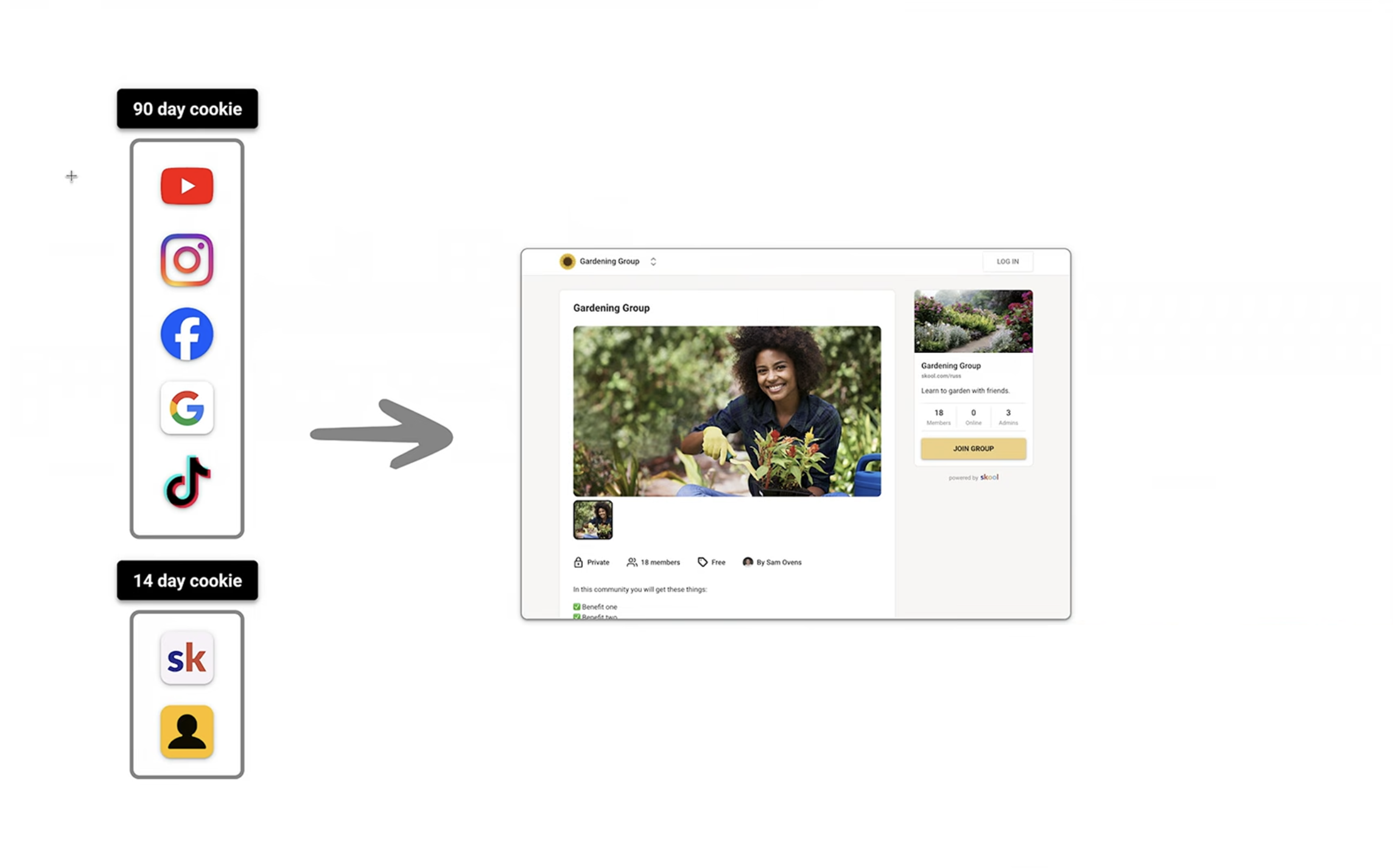
Skool uses a 14-day last-touch cookie: when someone clicks your link, a cookie is placed in their browser, and if they create a community within 14 days, the referral is credited to you. Skool also auto-attributes a helpful bonus: if a member inside a community you referred goes on to create their own community, that new referral is attributed to you automatically.
So the network compounds. Refer one creator, and the members they attract who later launch their own communities can roll up to you without any extra effort, which is a quieter but real part of the program's upside.
How do you get paid?
Payouts run monthly through FirstPromoter once your balance passes the $100 minimum threshold, and funds transfer to your connected payout method within a few business days. There are no fees to join and no cost to stay in the program. You get a dashboard showing clicks, signups, active referrals, and pending versus paid commission.
Practically: join the program, grab your link, promote it to the right audience, and once enough referrals create and keep communities to clear $100, Skool pays you every month automatically.
Who this program is actually for: creators, coaches, and educators who already talk to people thinking about building an audience or a paid community. If your content or audience overlaps with "starting an online business," the Skool affiliate program is one of the strongest recurring-commission offers available, because 40% recurring beats the one-time or low-percentage payouts most SaaS programs offer.
How to actually promote it (without being spammy)
Lead with value, then let the link follow. The affiliates who earn the most build genuinely useful content around starting and running a community, then place their link where a ready-to-build reader naturally wants it. Reviews, honest comparisons, and step-by-step start guides convert far better than raw link-dropping.
A simple starting playbook: pick one angle you can speak to (a niche, a pricing question, a platform comparison), publish something genuinely helpful about it, and include your link as the obvious next step. If you want to understand what you are recommending, start by reading how much Skool costs, how much Skool takes in fees, and how to start a Skool community.
Frequently asked questions
How much does the Skool affiliate program pay?
It pays 40% recurring commission on your referral's Skool subscription, every month they stay. On the Pro plan ($99/month) that is about $39.60/month per active referral; on the Hobby plan it is about $3.60/month. Because it recurs, active referrals stack into predictable monthly income rather than one-time payouts.
Is the Skool affiliate program free to join?
Yes. There is no cost to join and no ongoing fee. You sign up, get a unique affiliate link tracked through FirstPromoter, and start promoting. You only need a Skool account to participate, and you do not have to be a paying community owner to earn commissions.
When does a Skool affiliate commission actually trigger?
The commission triggers when your referred person creates their own Skool community, not just when they sign up or join a group. This is the rule people miss most often. It means your best audience is would-be community builders, coaches, and creators, not casual browsers who never launch anything.
How long is the Skool affiliate cookie?
Skool uses a 14-day last-touch cookie. If someone clicks your link, they are credited to you as long as they create a community within 14 days. Skool also auto-attributes referrals when a member of a community you referred later creates their own community, which extends your reach beyond the direct click.
When and how do Skool affiliates get paid?
Payouts are monthly through FirstPromoter once your balance passes the $100 minimum. Funds transfer to your connected payout method within a few business days of the monthly run. Your dashboard tracks clicks, signups, active referrals, and pending versus paid commission so you always know where you stand.
How much do Skool affiliates actually make?
Publicly shared figures from affiliates in 2026 range from around $2,000 a month to around $30,000 a month, with $25,000 also reported. The spread is driven by who the affiliate's audience is rather than how much traffic they send, because commission only triggers when a referral creates their own community. An audience of coaches and course sellers converts at a completely different rate to a general-interest audience at the same click volume.
Can Skool affiliates see who joined through their link?
No. The dashboard reports clicks, signups, active referral counts and pending versus paid commission, but not the identity of individual referrals or what they went on to sell inside their own communities. If you need to know which piece of content produced a referral, track that on your own side with distinct landing pages or link paths, because the affiliate dashboard will not attribute it for you.
Updated August 2026. Commission rate, cookie window, and payout terms reflect publicly listed figures for the Skool affiliate program and can change; confirm current terms on skool.com before promoting.
Start your Skool community
Ready to build a community of your own? Start on Skool through our link. We may earn a commission if you create and keep a paid community, at no extra cost to you.
Start your Skool community →Keep reading

Skool Webinar vs Skool Call: Which Should You Run?

Skool Referral Program: How Member Affiliates Work

Skool Invite Link: 4 Ways to Invite Members (2026 Guide)

Skool Facebook Pixel & Ads Tracking Setup (2026 Guide)

Skool Chat Explained: DMs, Limits and Group Chat (2026)

Skool AutoMod: How to Stop Spam in Your Community (2026)
Skool Analytics Explained: Every Metric in the Dashboard
How to Delete a Skool Account (There Is No Button)
Skool Membership Tiers Explained: How to Run Multiple Paid Plans in One Community (2026)