Luthiers Mastermind Lab: 34 Members, $89, Rank 50
Luthiers Mastermind Lab is Sofia Vettori's Skool room for violin makers: 34 members, $89 a month, 1,801 posts and 74 visitors, at Music rank 50.

Luthiers Mastermind Lab is Sofia Vettori's private Skool community for violin makers, priced at $89 a month, with 34 members and two admins. On the 29 August 2026 pull it sat at rank 50 in the Skool Games Music category on 74 visitors and $2,644 of monthly recurring revenue, which makes it one of the smallest rooms we have broken down that still holds a category place, behind only the 26-member Looper Collective in Hobbies.
The numbers
- Music niche (violin making, luthiery, bench work)
- Rank 50 in the Skool Games Music top 50, 2,354 globally
- 34 members, private
- $89/mo, no trial and no annual option shown
- 2 admins, roughly one for every 17 members
- 1,801 posts since 30 October 2024
- $2,644 monthly recurring revenue on Skool's own board
- 74 visitors in the reported window
- 5.0 from 2 Skool reviews, far too small a sample to read
Who is Sofia Vettori?
Sofia Vettori is a working violin maker who runs the room as @sofia-vettori-8894, an account dating from 24 October 2024, six days before the community itself. Her Skool bio is two lines and gives the whole positioning away: more art, beauty and harmony to save our world, violinmaker during the day, serial knitter during the night.
Her name carries real search demand outside Skool. Google's autocomplete for "sofia vettori" returns violin, violin for sale, violin price, violin maker, violin review, varnish, cello and viola, which is the query shape of a maker whose instruments people are considering buying, not of a course seller. That matters here, because it means the community is downstream of an existing craft reputation rather than the other way round.
We assert nothing about her training, her workshop or the prices of her instruments.
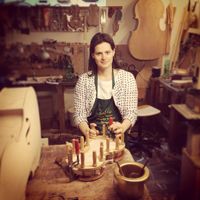
How Luthiers Mastermind Lab sells
It sells company, and it does not pretend otherwise. The about page opens with three questions that only make sense to somebody already at a bench: will you spend 45 minutes on a scraper bevel, will five hours on a violin template be enough, is "do you seal your bridges, and with what" keeping you awake at night. If those questions land, you are the customer. If they do not, nothing later in the page will rescue it.
That is a deliberately narrow door and it explains the 34 members. But it also explains why the room can charge $89 to people who could learn the same techniques from books. What the page promises is not instruction. It is the line "ask any question and feel less alone at your bench", which is a description of the actual condition of a craft practised alone in small workshops.
The sharpest sentence is an accusation aimed at the buyer's own industry: join this group of welcoming and judgmental free violin makers, followed by a parenthetical that says, in effect, I know, this is insane given how our industry normally behaves. It positions the community against a norm rather than against a competitor. And the page closes on "don't tell Maestro", a joke about apprenticeship secrecy that doubles as the room's entire reason to exist.
What the about page actually says
The page below is short, and almost all of its work happens in the first sixty words. Here it is in full, emoji stripped and otherwise as published, with five lines marked. Hover a marker to see what that line is doing.
Is the question "Do you seal your bridges, and with what?" keeping you awake at night!
If the answers are YES, then this group is for you!!!
2Join this group of welcoming and judgmental free violinmakers and violin making lovers (I know!!! pretty insane knowing the normal behavior in our industry).
3Ask any question and feel less alone at your bench. We are here to celebrate other people's wins and keep you accountable!
One zoom meeting LIVE every week
Community chat support every time
4Special guests are invited to speak about special topics depending on the group need and desire!
Recordings available of all the past meetings and the Special Guests Masterclasses too!
Having fun wile we make what we love
5a Map to see where your people are, because the best part of being a violinmaker? knowing that you will have a friend in every corner of the world!
don't tell Maestro!
Thirty-four members, and a category place
Thirty-four members is not a rounding error in this category, it is the whole business. To see how unusual that is, put it beside the other Music rooms we have measured on the same day's pull.
| Music room | Members | Price | Music rank | Visitors |
|---|---|---|---|---|
| Mastering.com Members Club | 37,025 | $29/mo | 4 | Not in this pull |
| Key Learners Piano Club | About 2,300 | $1/mo | 20 | 846 |
| Pro Gig Academy (Plus) | 104 | $125/mo | 19 | 343 |
| Luthiers Mastermind Lab | 34 | $89/mo | 50 | 74 |
The room reaches a category place on a roster that would fit in one workshop. It does that the only way arithmetic allows, by charging enough that a very small number of people clears the threshold. Skool's board reports $2,644 a month for the room, and 34 members at $89 with two unpaid admin seats would top out near $2,848, so the published figure is consistent with almost the entire paying roster being on the list price.
What 74 visitors means: this is the lowest traffic figure in any breakdown we have published. The room is not being discovered, it is being joined by people who already know who the founder is. A community can hold a rank on essentially no traffic when its price is high enough and its audience arrives pre-sold.
1,801 posts across 34 members
That is about 53 posts for every current member, the highest ratio in our Music set, though only narrowly ahead of The Sync Alliance at about 49. Pro Gig Academy (Plus) runs about 21 per member and that already looked high.
The usual caveat applies and applies hard here. Posts accumulate from October 2024 while members are counted today, so this is a lifetime total against a current roster, not a rate. If the room has churned members over twenty-two months, the denominator is understating how many people produced those posts.
Even discounted, the shape is meaningful. A room with a weekly call and a chat where the subject matter is bench problems generates a post every time somebody photographs a bad seam. That is a different content engine from a course community, where posting is a task somebody has to be prompted into.
What Skool's board actually reports
The Skool Games board now publishes a monthly recurring revenue figure next to every ranked room, which is worth stating plainly because it settles arguments we have had in earlier breakdowns. The board is ordered by revenue, not by traffic or by size, and the four Music rooms in today's batch line up exactly as that ordering predicts.
| Room | Music rank | Reported MRR | Visitors |
|---|---|---|---|
| The Composer Training Studio | 34 | $3,980 | 546 |
| Bateristas del Reino | 42 | $3,105 | 2,299 |
| Music Funding Academy | 44 | $2,876 | 309 |
| Luthiers Mastermind Lab | 50 | $2,644 | 74 |
Traffic in that table runs from 74 to 2,299 with no relationship to rank at all. Revenue runs cleanly downhill. Two of the four rooms in that table clear $3,000, which is the threshold at which Skool awards a founder the clover status badge documented in the same breakdown. That badge sits on the person rather than on a single room, so it is not a per-room reading, but it is a reminder that the platform itself treats revenue as the unit of ranking.
The funnel, step by step
There is barely a funnel, and that is the point worth copying. A craft reputation sends a small number of the right people to one paid room with no free tier, no trial and no annual plan.
No trial is a real decision at this price. Most rooms in this range use seven days to convert curiosity, as Chase's Guitar Academy and others do. Removing it means the about page has to do all the qualifying on its own, which is exactly why it opens with scraper bevels instead of a promise.
Three things worth stealing from this page
Write the door narrow on purpose. The first line of this page would repel almost every reader on the internet and delight the few thousand people worldwide who make violins. If your product genuinely serves a small trade, a wide headline recruits people who will churn in month two, and the honest version of the pitch is a better filter than any qualification form. That principle is the whole argument in how to write a Skool about page.
Sell the isolation, not the information. Violin making technique is in books that cost less than one month here. What is not in books is somebody answering at eleven at night when a bridge is not sitting right. Any craft practised alone has the same gap, and it is a subscription-shaped gap because it recurs.
And price for the size of the trade you are in. Thirty-four people at $89 is a real monthly income. Three thousand four hundred people at $89 does not exist in violin making at any price, so the pricing question was decided by the niche before the founder got to it, and pretending otherwise is how small-trade communities end up cheap and unsustainable. The wider version of that decision is in how to price a Skool community.
Frequently asked questions
What is Luthiers Mastermind Lab?
Luthiers Mastermind Lab is a private Skool community for violin makers run by Sofia Vettori. It has 34 members, two admins and costs $89 a month with no trial and no annual option displayed. Members get one live Zoom meeting a week, a community chat, invited guest speakers chosen by what the group asks for, recordings of past meetings and masterclasses, and a member map. It has posted 1,801 times since 30 October 2024.
How much does Luthiers Mastermind Lab cost?
Eighty-nine dollars a month, billed monthly, with no free trial and no annual plan shown on the about page at the time of our 29 August 2026 pull. Skool's own leaderboard reports $2,644 in monthly recurring revenue for the room, which is close to what 34 members at the list price would produce once the two admin seats are excluded.
Who is Sofia Vettori?
Sofia Vettori is a violin maker and the founder of Luthiers Mastermind Lab. Her Skool account dates from 24 October 2024 and her bio describes her as a violin maker by day and a knitter by night. Search interest in her name is dominated by her instruments rather than her teaching, which suggests the community sits downstream of an existing craft reputation. Her Skool profile lists no location, so we do not assert one.
How do you become a luthier?
There are three routes people generally describe. Formal violin making schools run multi-year full-time programmes and are the most common path into professional bench work. Apprenticeship under an established maker is the older route and still exists, though places are scarce and usually unadvertised. Self-teaching from books, plans and courses is how most hobbyists start, and it is workable for a first instrument but slow on the judgement calls, which is precisely the gap a peer community is selling into.
What is a person who makes violins called?
A luthier. The word covers makers of stringed instruments generally, including guitars, so violin makers are often specified as violin makers or violin luthiers when the distinction matters. Repair and restoration specialists are frequently called luthiers too, even when they do not build new instruments.
How much does it cost to make a violin?
Materials for a first instrument, meaning a tonewood set, fittings, strings and varnish, commonly run into the low hundreds of dollars, while tools are the larger and more variable outlay. The bigger cost is time. A first violin typically takes a beginner many months of evenings, which is one reason accountability rather than instruction is what a room like this is really selling.
Can a 34-member community be a real business?
On these numbers it is one. Skool reports $2,644 a month, which is a meaningful income in most places for a room that requires one live call a week and a chat. The constraint is not marketing, it is the size of the trade: there is no version of this community with ten thousand members, so the model only works because the price was set against what the work is worth rather than against what other online communities charge. The general logic of small rooms at high prices is covered in Skool membership tiers.
Start your Skool community
Ready to build a community of your own? Start on Skool through our link. We may earn a commission if you create and keep a paid community, at no extra cost to you.
Start your Skool community →Keep reading

Music Funding Academy Review: The Numbers Skool Shows

Bateristas del Reino: The $10,000 Skool Join Button
Ingenieria Musical Skool: The $100,000 Closed Sign

Jooba Guitar: Jaco Uys Sells a $10 Room for $3 on Skool

Dave Simpson Guitar World: The $35 Skool Room Reviewed

Clarity Guitar Studio Review: Andre Fludd's $69 Skool
Alex Graf Bluegrass Guitar: Inside the $25 Skool Club

Shredders University Review: Jack Wood's $127 Skool

The Music Licensing Club: Eric Campbell's $9 Skool
