Skool News #71: The Growth Boost Bidding System Explained
Skool News #71 turned Growth Boost from a fixed 30% commission into a bid. Owners can now offer a higher cut to win more of Skool's paid traffic. Here is how the auction works, what it costs, and when bidding up is worth it.
Skool News #71 changed the single most important number in Growth Boost. Until now, Skool took a flat 30% of any paying member it sent you and there was nothing to decide beyond on or off. From this episode, the percentage is a bid: offer Skool a bigger cut of the customers it brings you, and Skool sends more of its ad budget your way. Growth Boost stopped being a switch and became an auction.
What shipped in Skool News #71
- Bidding on Growth Boost, so owners can offer more than the default cut to win more traffic
- Skool says it is spending as much as possible promoting communities, and higher bids let it go harder
- A walkthrough of how Growth Boost works, a FAQ, and the Growth Boost stages
- The default cut remains 30% of what a Skool-sourced member pays, per Skool's help centre
- Announced by Sam Ovens on 25 August 2026 inside Skoolers, 525 likes and 379 comments in its first eight hours
- Runs 22 minutes 46 seconds, the longest chapter being the bidding explanation
Watch the full episode ("Growth Boost Bidding System | Skool News #71") on Skool News. Announced by Sam Ovens in Skoolers. All credit to the Skool team.
What the bidding system actually changes
Growth Boost previously had one setting: on or off. On meant Skool could promote your community through Discovery, the recommended groups sidebar and its own paid ads, and in exchange Skool kept 30% of whatever a member it sourced paid you, for as long as that member stayed subscribed. Skool News #71 adds a dial to that switch, so you can offer a larger share and compete for a larger slice of Skool's ad spend.
Here is the announcement post in Sam Ovens's own words, as published in Skoolers:
• Now you can bid more for growth boost if you want more traffic!
• We're spending as much as possible promoting you guys - this helps us go harder!
• How growth boost works
• Growth boost FAQ
• Growth boost stages
The second line is the part builders should read twice. Skool is not describing a fee increase, it is describing a budget constraint. Skool fronts the ad money and only earns it back when a referred member pays, so a community offering a higher percentage is a community Skool can afford to advertise more aggressively. The bid is really a signal of how much customer acquisition cost you are willing to fund.
The default is still 30%, and the higher numbers are owner-reported
Skool's own help centre still documents the standard arrangement in plain terms: "If Skool brings you a paid customer and your group price is $10, Skool deducts $3 and fees, depending on the selected plan. If you bring your own customer, Skool only deducts the processing fees." That 30% baseline is what you get if you leave the setting alone.
Owners in the announcement thread report the new dial goes considerably higher. Taha Asadi wrote that "Growth Boost already lets us dial the percentage up to 70%", Coach SCG asked "Who else is going 70%?", and Ossie Osmond and Lau Brizuela both referenced 70% in their replies. We are reporting that ceiling as what community owners are saying in the official thread on day one, not as a figure we have read off the settings screen ourselves. Check SETTINGS then Discovery in your own group before you plan around any specific number.
Update, 26 August 2026. A fifth owner has now described the control and the ceiling in his own words. Mike Holp posted "Maxxed Out My Growth Boost Slider" in the Skoolers community, writing that "Skool recently announced the new Growth Boost slider feature so I decided to max it out to 70% to get maximum new members for my community" and that he has "everything to gain and little to lose". Two details are worth taking from that. The control is described as a slider rather than a set of preset tiers, and 70% is again named as the top of it. It remains owner-reported, and the sentence to keep is his last one, because the thing he has to lose is 70 cents of every dollar of Skool-sourced revenue, before processing fees, for as long as that member stays.
The live question in the thread is not whether to bid but when to stop. Artin Asghari, whose community is already receiving around 20,000 visitors and who describes Growth Boost as outperforming $20,000 a month of his own advertising, asked the thread how anyone should decide whether to raise the percentage when the boost is already working at the default. Nobody has published a rule for that yet. The honest answer is that raising the bid buys volume with margin, so the number only makes sense against your own retention: a member who stays twelve months can justify a bid that a member who stays two months cannot.
Flat commission vs bidding: what changed
| Growth Boost before #71 | Growth Boost after #71 | |
|---|---|---|
| The decision | On or off | On, off, or how much to bid |
| Skool's cut | 30% of a Skool-sourced member | 30% by default, higher if you bid up |
| What extra spend buys | Nothing, everyone paid the same rate | More of Skool's ad budget pointed at you |
| Who wins the traffic | Whichever communities Skool judged most efficient to promote | That judgement plus willingness to pay |
| Risk | Giving away 30% of network members | Giving away a much larger share on a page that may not convert |
| Applies to | Recurring charges while the member stays | Recurring charges while the member stays |
The bottom two rows matter most. A higher bid does not buy you a better about page, and Growth Boost's cut applies to recurring charges for the whole life of that member's subscription, not just the first payment. Bidding up on a page that converts poorly means paying a premium rate for traffic that was never going to buy. We covered how Skool decides who deserves budget in the first place in our breakdown of Skool's efficiency score.
The attribution rules that decide whether you pay at all
Growth Boost only takes its cut when Skool is the attributed source, and Skool uses last-touch attribution. Whichever link a member clicks at the end of their journey gets the credit, and once locked, the attribution cannot be changed by anyone, including Skool support.
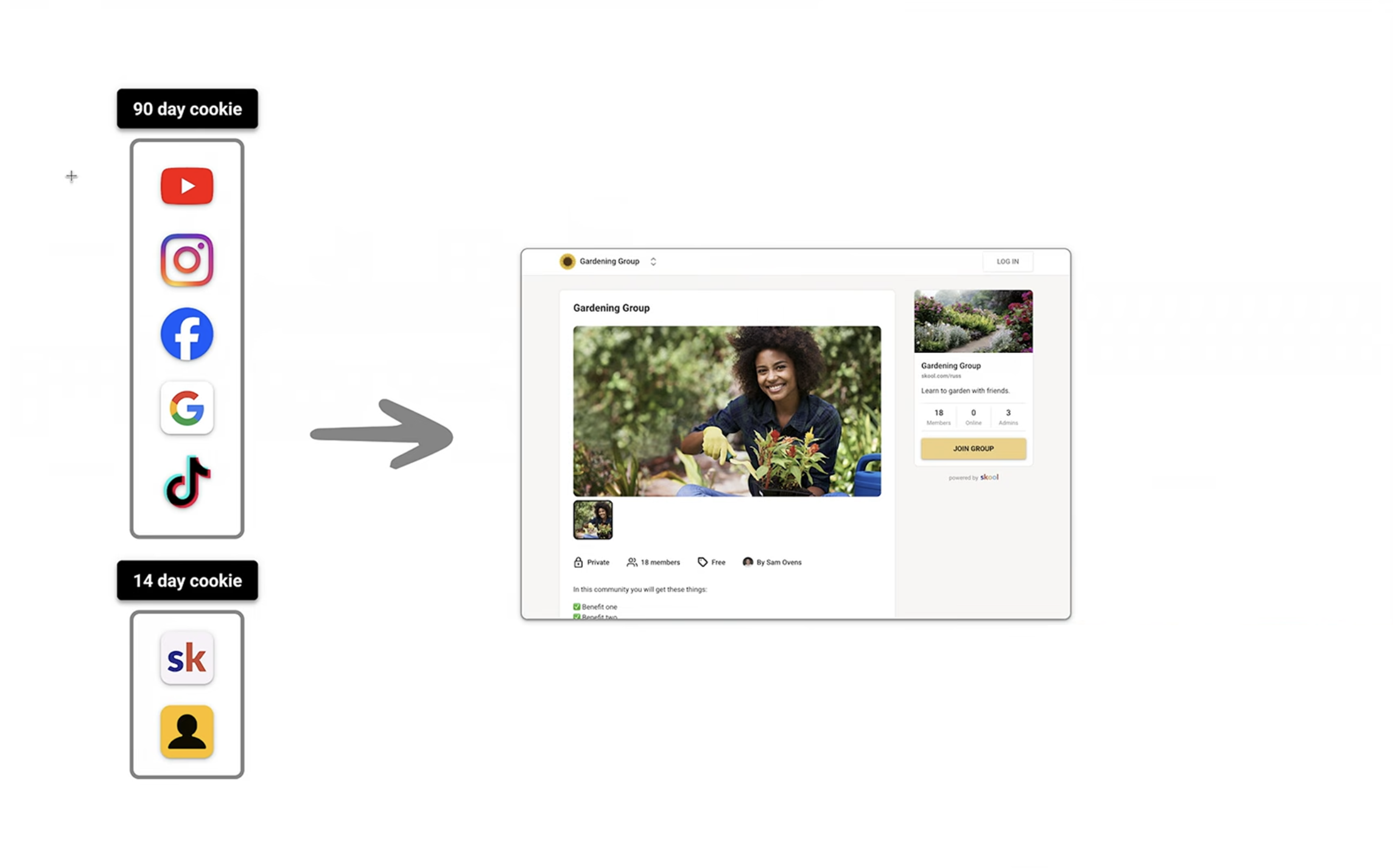
Two details are worth memorising before you raise your bid. The attribution window for the Skool network and for affiliates is 14 days, against 90 days for every other traffic source. And if someone sees a Skool ad for your group, then joins from a link in your own Instagram bio, Instagram gets the attribution and Skool gets nothing. In practice, owners who send a lot of their own traffic pay Growth Boost on a smaller share of signups than the headline percentage suggests.
Read the bid as an acquisition cost, not a fee: bidding 50% on a $50 community means paying $25 a month for as long as that member stays. That is only a good trade if your retention is strong and your page converts. Fix the about page first, then bid.
Growth Boost stages, and why the episode spends time on them
The final chapter of the episode covers Growth Boost stages, which is Skool's way of saying that not every community gets the same treatment on day one. Communities have to earn their way into meaningful ad spend by proving that traffic sent to them converts and sticks, which is the same logic behind the efficiency score.
That is the honest constraint on the bidding system. A brand new community cannot simply buy its way to the front of the queue by offering whatever the maximum bid turns out to be, because Skool has no evidence yet that the money would come back. The bid raises your ceiling; the conversion and retention data decide whether you reach it.
What to do this week
Check your current setting. Growth Boost is on by default and lives under SETTINGS then Discovery, so if you have never looked, you are already in the programme at the default rate.
Work out your break-even before you touch the dial. Take your average member lifetime in months, multiply by your price, and ask what percentage of that you would happily pay an affiliate for the same customer. Our Skool affiliate programme guide is a useful comparison, because it is the same economics with a different counterparty.
Then fix the page the traffic lands on. Every extra point you bid is wasted on a page that does not convert, and the cheapest conversion gain available to most owners is still an about page rewrite. Start with how to write a Skool about page, then how to rank higher on Skool Discovery, and check the real-world numbers in Growth Boost results from actual communities.
Frequently asked questions
What is the Skool Growth Boost bidding system?
It is the change shipped in Skool News #71 on 25 August 2026 that lets community owners offer Skool a larger percentage of Growth Boost referred revenue in exchange for more of Skool's advertising budget being spent promoting their community. Before this, every community paid the same flat 30% and the only choice was whether Growth Boost was on or off.
What is Skool Growth Boost?
Growth Boost is Skool's programme for promoting your community using Skool's own money. It places your group at the top of Discovery search results for relevant keywords, features it in recommended groups, and lets Skool run off-site ads for you. Skool fronts the cost and only earns when a member it sourced actually pays.
How much does Skool Growth Boost cost?
There is no upfront cost. Skool deducts a percentage of what a Skool-sourced member pays you, for as long as that member's subscription stays active. The default is 30%, so on a $10 community Skool takes $3 plus processing fees. After Skool News #71 you can choose to bid a higher percentage to attract more traffic.
Should I bid higher than 30% on Growth Boost?
Only if your about page converts well and your members stay. The percentage applies to every recurring payment for the life of that subscription, so a high bid on a community with weak retention is expensive. Owners with strong conversion and long member lifetimes have the most room to bid up, because they earn back the acquisition cost over more months.
Can I turn Growth Boost off?
Yes. Growth Boost is on by default and can be switched off at any time from SETTINGS then Discovery. Turning it off means Skool stops promoting your community and stops taking a cut of Skool-sourced members, though the cut continues on members Skool already brought you while their subscriptions remain active.
Does Growth Boost take a cut of members I bring myself?
No. Skool uses last-touch attribution, so the cut only applies when the Skool network is the final source before someone joins. Members who arrive from your own ads, your email list or your social profiles are attributed to those sources, and Skool only deducts standard processing fees on them.
Start your Skool community
Ready to build a community of your own? Start on Skool through our link. We may earn a commission if you create and keep a paid community, at no extra cost to you.
Start your Skool community →Keep reading
Skool Growth Boost Reset: What Changed and What to Do
Skool News #73: Growth Boost Masterclass
Skool News #72: The First $1,000,000 Month on Skool
Skool News #70: Skool Goes Global (Fast Payouts, Reviews for Everyone, 7 Languages)
Skool Just Added Reviews: How Community Reviews Work
Skool Now Speaks Your Language: Spanish and German Are Live
The New Skool Leaderboards and Traffic Maxing: How Growth Actually Works
Skool's Efficiency Score: The Real New Skool Game (Skool News #64)