Skool News #73: Growth Boost Masterclass
Skool News #73 explains the Growth Boost reset, four promotion stages, annual pricing, free-trial conversion and multilingual Discovery.
Skool News #73 is a 26-minute Growth Boost masterclass. Published on 8 September 2026, it confirms that rebuilt campaigns are live but may need one to two weeks to regain their previous spend, explains the four promotion stages, and gives owners concrete levers: send trackable traffic, improve packaging, offer annual billing, review trial conversion and adjust the Boost percentage only when the economics justify it.
What #73 changes
- Google reviews: Skool community reviews can now appear in Google results
- Language adaptation: Discovery, UI and public content adapt to a visitor's language
- Reset window: the rebuilt Growth Boost structure may need one to two weeks to restore scale
- Minimum data: at least 100 About-page visitors and one paid signup from a source in 30 days
- Four stages: data collection, insufficient efficiency, dedicated campaign, partnership campaign
- Trial benchmark: the hosts cited a platform average near 40%, with large group-level variation
What happened to Growth Boost?
Skool said it stopped and rebuilt the campaigns across a new account structure so it could apply lessons from the first version. The hosts reported better performance from the new structure, but warned that spend could take one to two weeks to return to its former scale. That makes a temporary decline after the reset a platform effect, not automatic proof that your offer suddenly failed.
204:00 to 06:00: Growth Boost reset and the one-to-two-week scaling window.
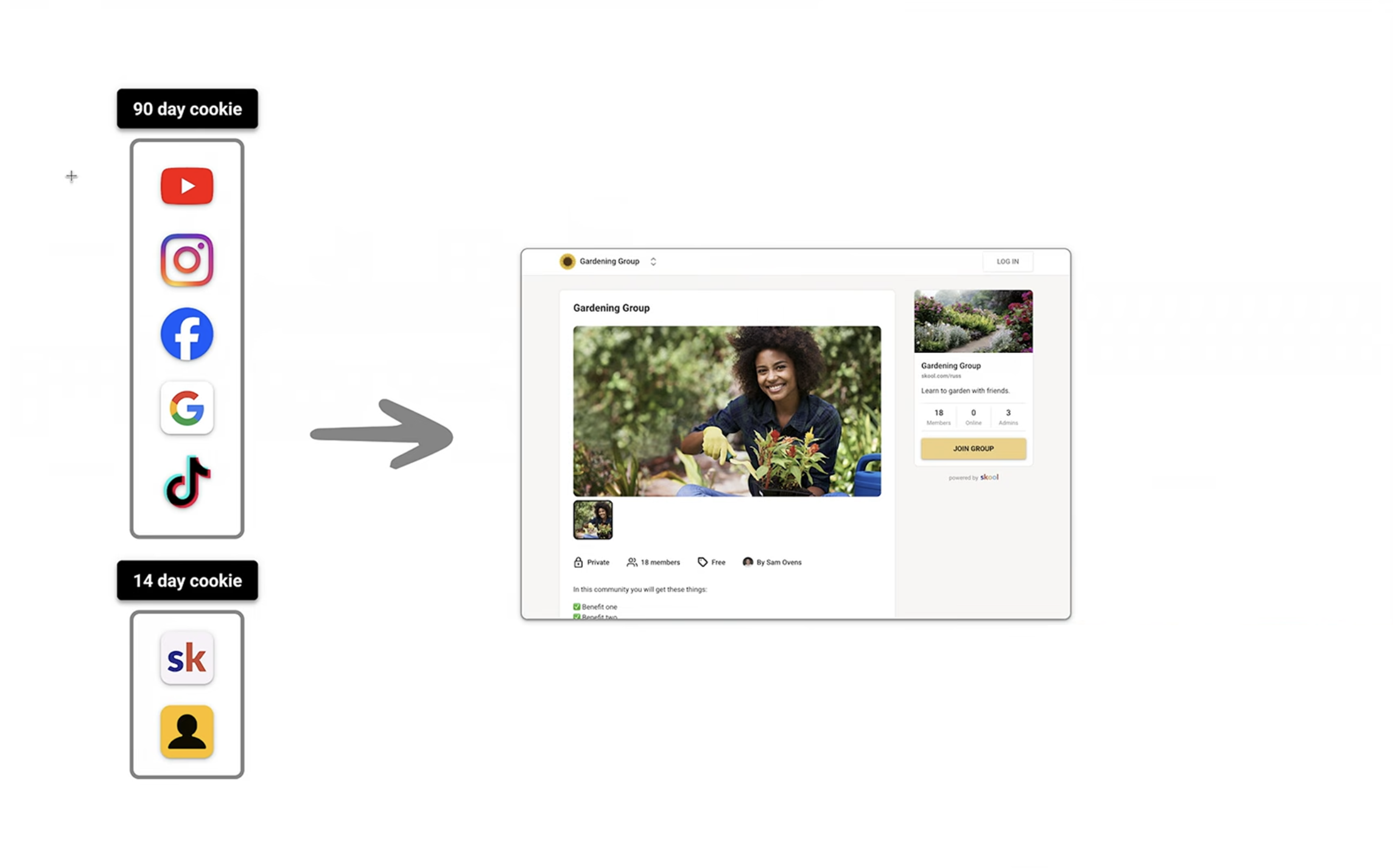
306:00 to 13:00: link-in-bio traffic, cover packaging, About pages and annual plans.
413:00 to 18:00: efficiency score, Boost percentage and trial conversion.
518:00 to 26:03: four promotion stages, examples and Discovery balance.
What are the four Growth Boost stages?
| Stage | What Skool sees | Promotion described in #73 |
|---|---|---|
| Not enough data | Fewer than 100 source-level visits or no paid signup in 30 days | Shared carousel exposure to collect signals |
| Enough data, weak economics | A score exists, but payback is too slow | Continued carousel testing |
| Good stats | Conversion, price, retention and bid support paid acquisition | Dedicated campaign with 20-plus creatives and roughly $1,000 to $5,000 daily spend |
| Great stats | Strong payback supports a partnership | Custom clips and roughly $5,000 to $10,000-plus daily spend |
Those spend figures were stated by Skool as examples, not promises to any owner. The practical first step is still to generate your own source-tagged traffic. Our Growth Boost percentage guide explains the bid trade-off, while the promotion guide covers traffic you control.
Which levers can an owner actually change?
First, place the Skool link in bios and video descriptions so visits retain a useful source. Second, make the Discovery card understandable to a stranger. Skool said the cover can become the ad creative, so clarity at thumbnail size matters more than decorative detail.
Third, add an annual option. The hosts recommended at least 20% and generally discussed 30% to 50% as the stronger range. Annual cash can shorten Growth Boost's payback period, but the discount must still work for your margins. Fourth, check the effective conversion of any trial. The episode cited an average near 40%, examples near 80% and 8%, and said the rebuilt system now evaluates trial conversion per group. See our free-trial guide before treating an average as a universal cutoff.
What changed in Discovery and languages?
Skool demonstrated the interface and public content adapting to Chinese, Spanish and German, and said recommended communities and ads would become language-aware too. It also said Discovery had previously leaned too heavily toward cheap groups, then briefly leaned toward higher prices while the team tuned the balance. The explicit warning was not to rebuild your pricing around a temporary ranking pattern.
Reviews appearing in Google are a separate trust change. It can help a branded searcher compare the community before visiting its page, but appearance and ordering remain controlled by Google. Read how Skool reviews work for eligibility and moderation context.
Skool of the Week examples
The episode used Matt Ryder's F The GuRUs as a stage-four Growth Boost example and showed $95,000 in monthly recurring revenue with 52% of traffic attributed to the Skool network. It also highlighted Good Eye Society at about $8,300 monthly and a Car Design Community at about $4,000 monthly. These are Skool dashboard snapshots presented on air, not audited financial statements or typical results.
The useful sequence: earn enough tagged traffic for a score, improve conversion and retention, then use annual pricing or a higher Boost percentage only when the unit economics still make sense.
Frequently asked questions
What is Skool News #73 about?
It explains the Growth Boost rebuild, four promotion stages, owner-controlled efficiency levers, multilingual Discovery and Google visibility for reviews.
How long will the Growth Boost reset take?
Skool said the new structure was already live but could take one to two weeks to return to its previous spend scale.
What data is needed for a Growth Boost score?
The episode named at least 100 About-page visitors and one paid signup from a specific traffic source during the last 30 days.
Should I raise my Growth Boost percentage?
Only after checking margin and payback. The hosts suggested a higher setting can move a group into an efficient category, but said groups already performing well do not need to change.
What annual discount did Skool recommend?
At least 20%, with 30% to 50% discussed as the range that tends to have more impact on upfront cash collection.
Did Skool guarantee ad spend or revenue?
No. The spend levels and community revenue figures were examples shown on air, not commitments or typical outcomes.
Start your Skool community
Ready to build a community of your own? Start on Skool through our link. We may earn a commission if you create and keep a paid community, at no extra cost to you.
Start your Skool community →Keep reading

Skool Growth Boost Reset: What Changed and What to Do
Skool News #72: The First $1,000,000 Month on Skool
Skool News #71: The Growth Boost Bidding System Explained
Skool News #70: Skool Goes Global (Fast Payouts, Reviews for Everyone, 7 Languages)
Skool Just Added Reviews: How Community Reviews Work
Skool's Efficiency Score: The Real New Skool Game (Skool News #64)
Skool Discovery Keywords: The New 11-Slot Field