Skool Discovery Keywords: The New 11-Slot Field
Skool Discovery keywords are new: 11 slots in your Discovery settings to describe your community. Here is where the field lives and how to choose them.
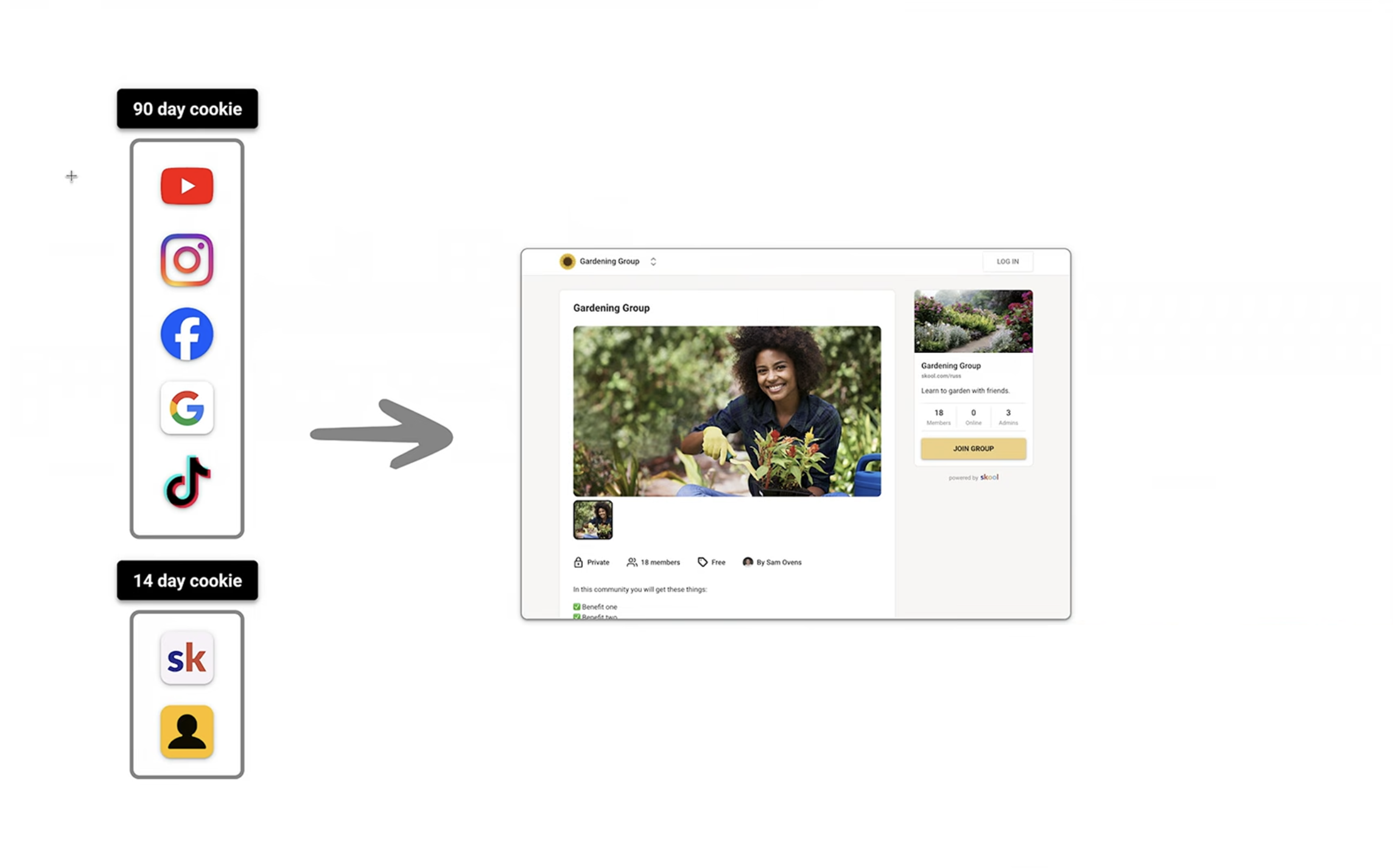
Skool has added a keywords field to the Discovery tab of community settings. It is marked NEW in the product, holds a maximum of 11 entries, and is labelled "Set keywords to help people find your community". It sits directly under your discovery status row, above the eligibility checklist, and it is the first owner-supplied input Skool has offered that is aimed specifically at Discovery matching rather than at readers.
What is new
- Where community settings, Discovery tab, directly under the status row
- Label "Set keywords to help people find your community"
- Limit 11 keywords, shown as a 0 / 11 counter
- Badge marked NEW in the product on 29 August 2026
- Also on the panel Showing in discovery, Category, Rank, Language
- Not yet documented Skool's Discovery FAQs, last updated 23 June 2026, do not mention keywords
- Verified on a live logged-in Discovery settings screen, not from a screenshot
Where is the Skool keywords field?
It is in your community settings, on the Discovery tab, immediately below the row that reads Showing in discovery, Category, Rank and Language. Open your community, click SETTINGS, then Discovery. The field is a single text input labelled Keywords with a counter in the bottom right that starts at 0 / 11.
If your group is unlisted, the field is still there and still editable. On an unlisted group the status row reads Showing in discovery: No, Category: None, Rank: None, Language: Unknown, and the eligibility checklist sits below the keywords box rather than replacing it. So you can fill the field in before you are listed, which is the sensible order to do it in.
What exactly does the panel say?
Four things, in this order. First the status row. Then a red NEW badge next to the heading "Set keywords to help people find your community", with the empty Keywords input under it and a 0 / 11 counter. Then, if you are not yet eligible, a warning box headed "Complete these steps to show in Discovery". Then a collapsible "How discovery works" section.
The eligibility checklist is worth writing down exactly, because owners guess at it constantly. It reads:
- Set your cover image
- Add group description
- Complete your about page
- Write your first post
- Get 3 friends to join
That is five items, and the third of them, the about page, is the one most owners half-finish. Note also that the checklist asks for three joins, not three hundred. Skool's own Discovery FAQs describe a "minimum threshold of members, posts, and activity" without naming a number, and this checklist is the closest thing to a number the product has ever shown.
Why did Skool add a keywords field?
Skool has not published a reason, so what follows is inference from the panel rather than an announcement. Until now, everything Discovery knew about your community it inferred: your category and your language are both assigned by Skool, and the panel still tells you to contact support if either is wrong. The keywords field is the first input in that pipeline that you control.
The obvious read is matching. Discovery has to decide which of a very large number of communities to show a given browsing member, and Growth Boost extends the same decision to off-site ads. Eleven owner-supplied words are a cheap, high-signal way to improve that match, in the same way that seller-supplied tags improve a marketplace search long before anyone builds a better ranking model.
The less obvious read is that it is a defence against bad categorisation. If you have ever been filed under the wrong category and told to email support, a keywords field is the polite version of a self-service fix.
Do this today: the field takes two minutes and there is no downside to filling it. Even if keywords turn out to carry little ranking weight, an empty field carries none, and the owners who fill it early will have the most data on whether it moved anything.
How should you choose your 11 keywords?
Pick the words a stranger would type when they do not yet know your community exists. That is the whole test. You have eleven slots, which is few enough that you cannot afford to spend one on your own brand name, because anyone typing your brand name has already found you.
A workable split for eleven slots:
| Slots | What goes in them | Example for a guitar community |
|---|---|---|
| 3 | The outcome the member wants | learn guitar solos, improve phrasing, play by ear |
| 3 | The problem in their words | stuck at intermediate, guitar plateau, boring solos |
| 2 | The format they are shopping for | online guitar course, guitar community |
| 2 | The audience they belong to | adult guitar learner, hobby guitarist |
| 1 | The adjacent skill they also search | music theory for guitar |
The reason the outcome and the problem get three slots each is that people search for both, and they search for the problem earlier. Somebody who types "guitar plateau" is further from buying than somebody who types "online guitar course", but there are more of them, and they have not yet been captured by anyone.
Two things not to do. Do not stuff the field with the same phrase in five variations, because the ranking penalties on the same panel include "spam or low quality engagement" and there is no reason to assume that spirit stops at the keyword box. And do not describe yourself the way you would to a peer. "Transformational container" is how you talk at a conference. "Learn guitar solos" is how somebody talks at eleven at night with a browser open.
The panel and the help centre no longer agree
This is the detail worth flagging, because it suggests the in-product list is the newer one. Skool's public Discovery FAQs, last updated 23 June 2026, list four ranking boosts and six penalties. The Discovery settings panel in the product lists four boosts and four penalties, and they are not the same four.
| Boosts | Help centre FAQ | In-product panel |
|---|---|---|
| High-quality artwork / about page | Yes | No |
| Interesting niche | Yes | No |
| Authentic human engagement | Yes | Yes |
| Active owner and admins | Yes | Yes (as "Active owner") |
| Owner driving traffic to about page | No | Yes |
| Payments on platform | No | Yes |
The two additions are the interesting ones. "Owner driving traffic to about page" says out loud that Skool rewards you for sending your own audience to your about page, which is exactly what Discovery then multiplies back at you. "Payments on platform" turns what was previously only a penalty in the FAQ into a stated positive.
Both lists agree on the three things that determine rank in the first place. The panel's wording: groups are ranked by member growth, engagement, and retention, and if you consistently grow your group, get members to engage, and keep them coming back, your rank will increase. Both also agree that removing inactive or level 1 members does not improve your rank, in the same sentence, ending with "some people like to lurk".
Does the keywords field replace ranking work?
No, and nothing on the panel suggests it does. Keywords are a matching input. Rank is still described as member growth, engagement and retention, in that phrasing, on both the panel and in the FAQ. Filling the field well should make you appear in front of more of the right people; it will not make you appear above a community with better retention.
One other thing worth doing in the same sitting: Skool has also added a TikTok field to profile social links, and given that "owner driving traffic to about page" is a stated boost on this very panel, the two changes point in the same direction.
The practical order has not changed either. Get listed first, because an unlisted community ranks nowhere no matter how good its keywords are. That means the five checklist items, and it means an about page that actually describes the offer, which we cover in how to write a Skool about page. Then work rank, which is covered in how to rank higher on Skool Discovery. Then, if you are paid and want Skool to spend its own ad budget finding you members, look at Growth Boost and the bidding change that shipped with Skool News 71.
What we do not know yet
Plenty, and it is better to say so than to guess. We do not know whether keywords feed Discovery search only, or the recommendation sidebar, or Growth Boost's off-site ad targeting, or all three. We do not know whether they are reviewed by the "human in the loop" that Skool's FAQ says manually reviews rankings. We do not know whether an empty field is neutral or slightly negative. And we do not know whether the eleven-slot limit is final.
What we can say with certainty is what is on the screen: a field, a NEW badge, a limit of eleven, and a label telling you it helps people find your community. We will update this post when Skool documents it.
Frequently asked questions
What are Skool Discovery keywords?
Skool Discovery keywords are a new field in your community's Discovery settings that lets you enter up to 11 words or phrases describing your community. The field is labelled "Set keywords to help people find your community" and carries a NEW badge in the product as of 29 August 2026. Skool has not yet documented the feature in its help centre, and has not stated exactly which surfaces the keywords affect.
How many keywords can you add on Skool?
Eleven. The input shows a counter reading 0 / 11 when empty. There is no visible way to buy or unlock more slots, and no stated character limit per keyword on the panel itself.
Where do I find the keywords setting on Skool?
Open your community, click SETTINGS, then select the Discovery tab in the left column of the settings dialog. The keywords field sits directly under the row showing your discovery status, category, rank and language, and above the eligibility checklist.
Why is my Skool group not showing in Discovery?
Because you have not cleared the eligibility checklist. The Discovery panel lists five items: set your cover image, add a group description, complete your about page, write your first post, and get three friends to join. Skool's own FAQ adds that once you hit the minimum threshold the group usually becomes visible within an hour or two, after Skool's review, and that if your category or language is wrong you have to contact support rather than change it yourself.
Do Skool keywords affect your Discovery rank?
There is no evidence that they do, and the panel does not say so. Rank is described on the same screen as being determined by member growth, engagement and retention. The keywords label says they help people find your community, which is a matching claim, not a ranking claim. Treat them as a way to be shown to the right people rather than a way to be shown higher.
Should I put my community name in the keywords field?
Probably not, unless you have a slot spare. Someone searching your community name has already found you. With only eleven slots, the higher-value use is the language of people who do not yet know you exist, which is usually the outcome they want or the problem they have rather than your brand.
Start your Skool community
Ready to build a community of your own? Start on Skool through our link. We may earn a commission if you create and keep a paid community, at no extra cost to you.
Start your Skool community →Keep reading

Skool Social Links: TikTok Is the New One
Skool News #73: Growth Boost Masterclass

Skool Growth Boost Reset: What Changed and What to Do
Skool News #71: The Growth Boost Bidding System Explained
The New Skool Leaderboards and Traffic Maxing: How Growth Actually Works
Skool News #72: The First $1,000,000 Month on Skool
Skool News #70: Skool Goes Global (Fast Payouts, Reviews for Everyone, 7 Languages)
Skool Just Added Reviews: How Community Reviews Work