Skool Facebook Pixel & Ads Tracking Setup (2026 Guide)
Skool has native Meta pixel, Google Ads and Hyros tracking plugins. What each one actually fires, how to set them up, and the mistake that breaks purchases.

Skool has a native Meta pixel plugin that tracks page views, membership requests and purchases on your group's About page, plus separate plugins for Google Ads and Hyros. You install it by pasting your pixel ID into SETTINGS, then Plugins, with no code and no tag manager. That is enough to run Facebook and Instagram ads straight to your community with conversion tracking and to retarget everyone who visited your About page. Here is the setup, how to verify events actually fire, and the mistake that silently breaks purchase tracking. Updated September 2026.
Skool ad tracking at a glance
- Meta pixel: page views, membership requests, purchases
- Google Ads plugin: page views and signups, Pro plan
- Hyros: server side, legacy admins only
- Where: SETTINGS, then Plugins
- Retargeting: yes, About page visitors
- Do not: add GTM inside your datasets
- Do not: reuse one pixel ID across domains or CRMs
What does the Skool Meta pixel actually track?
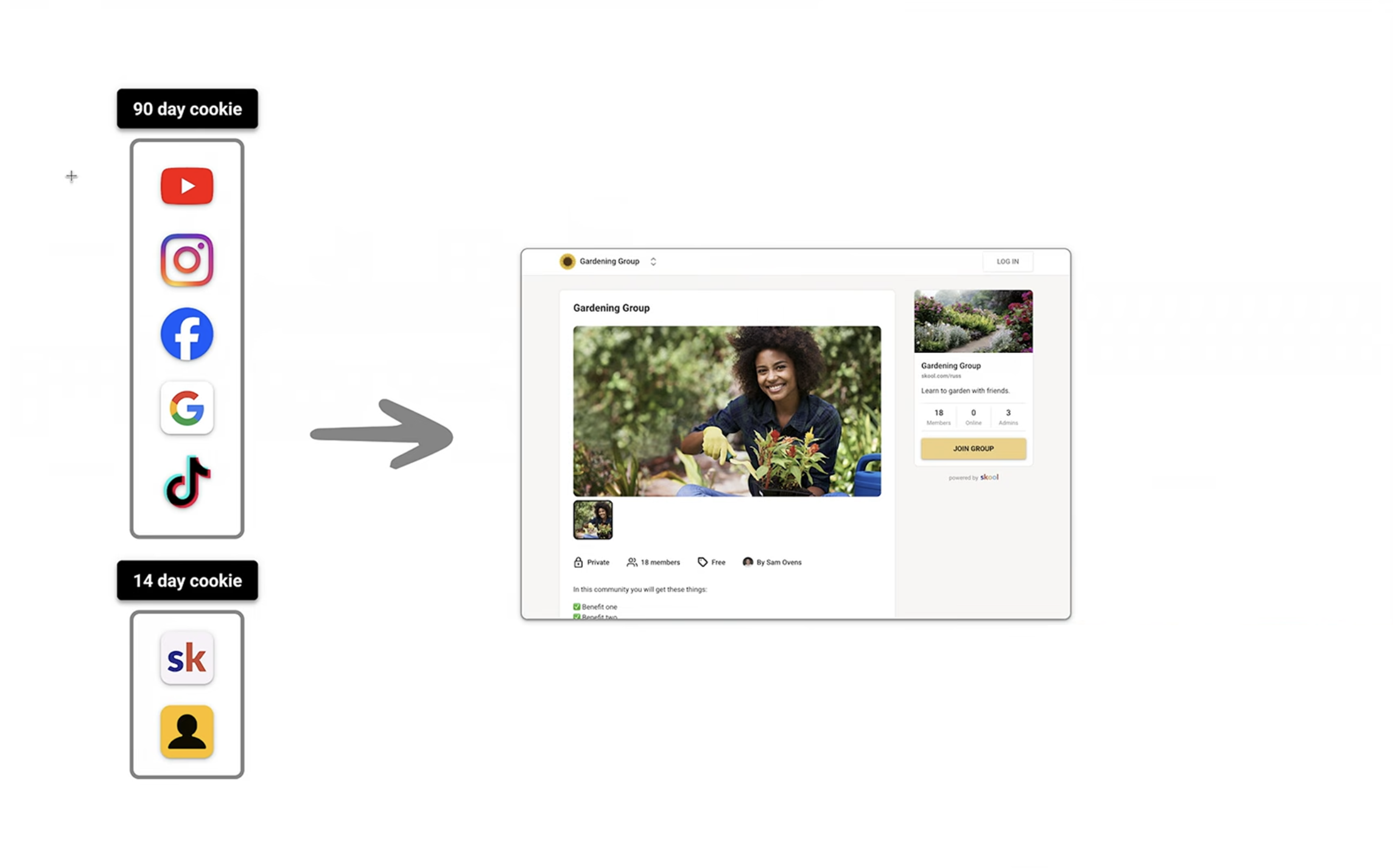
Skool's Meta plugin tracks page views, membership requests and purchases. In practice that means you can see who landed on your About page, who asked to join, and who paid, which is the full funnel for a Skool community. You can also build retargeting audiences from About page visitors, which is the cheapest audience most community owners have and the one almost nobody uses.
Skool's own framing is that this gives you everything you need to grow a free or paid group with ads. The reason it works without code is that your About page is a Skool page, so Skool fires the events for you rather than asking you to install anything.
How do you set up the Facebook pixel on Skool?
Open SETTINGS, go to Plugins, and enter your pixel ID. Skool provides a short video walkthrough in its help centre. There is no snippet to paste into a head tag, because you do not control the page.
Then test it properly rather than assuming. Skool's documented verification routine is:
- In your Meta dashboard, make sure Track events automatically without code is off, then click Open event setup tool.
- Paste your group's URL into the modal and click Add events.
- This opens your About page with a window. If any events are already listed there, delete them all, then save.
- Install the Meta Pixel Helper Chrome extension and confirm the events fire.
Step 3 is the one people skip, and leaving stale manually-configured events in place is a common cause of double counted conversions.
Why is my Skool pixel not tracking purchases?
Usually because of configuration rather than a Skool bug, and two causes account for most cases: Skool.com is not on your Meta Business traffic allowlist, or the same pixel ID is being reused across other domains or wired into a CRM, which splits and misattributes events. Work Skool's own checklist before assuming the platform is broken. Its core technical checks are:
- Add Skool.com to your allowlist for traffic permissions in Meta Business settings.
- Use the Meta Pixel Helper extension to confirm installation and surface errors.
- Check the Pixel Health section in Events Manager and follow any listed fixes.
- Use Events Manager, then Test Events to validate real time firing by simulating a pageview, signup or purchase.
Then the account-level checks: disable other browser scripts and extensions that may interfere, confirm ad blockers or privacy settings are not blocking the pixel, check your Meta account has no restrictions or flags, clear cache and cookies, and verify all domains associated with your pixel in Business Manager so attribution is not split.
Third-party consultants market a Conversions API workaround for missing Skool purchase events, typically wiring Skool to Meta through Zapier. Bear in mind that Skool's Zapier plugin exposes a deliberately small set of triggers and actions, as covered in our Skool API and integrations guide, so confirm the specific trigger you need exists before paying anyone. Run Skool's own checklist first either way, because paying to patch a misconfigured allowlist is an expensive way to fix a five minute problem.
The mistake that breaks tracking
Skool gives one explicit warning, and it appears in near-identical terms in both its Meta and Google Ads documentation: do not add trackers such as GTM within your datasets, do not reuse the same pixel ID across multiple domains, and do not connect your Skool group's pixel ID to external CRMs. Skool's stated reasons are that trackers may interfere with its native tracking and reporting, and that ID reuse causes duplicate or misattributed events, purchases especially.
The practical upshot is a single, dedicated pixel ID for your Skool group. This is counterintuitive if you run a wider business, because the instinct is to keep one pixel across every property so audiences accumulate in one place. On Skool that instinct is what corrupts your purchase data, and corrupted purchase data means Meta optimises your campaigns toward the wrong people. Create a fresh pixel for the group and leave it alone.
Google Ads and Hyros on Skool
Skool ships two more tracking integrations, and they are not equivalent to the Meta one.
| Integration | Events tracked | Plan | Notes |
|---|---|---|---|
| Meta pixel | Page views, membership requests, purchases | Not stated by Skool | Retargeting supported |
| Google Ads | Page views and signups | Pro | Covers Google and YouTube ads |
| Hyros | Page view, membership request, purchase | Legacy admins only | Server side events |
Google Ads needs two values: your Google Tag ID, from Google Ads then Tools then Data Manager then Manage then Configuration, and a Conversion label, from Goals then Create conversion then Sign Up Conversion then Use Google Tag Manager then Conversion labels. That Google Tag Manager step is only how Google surfaces the label for you to copy; it does not mean installing GTM on your Skool group, which Skool advises against. Note the narrower event set: page views and signups, not purchases. Skool's advice is to turn it on even if you are not running Google ads yet, because it starts collecting retargeting data you can use later.
Hyros sends its three events server side, which is why it survives browser-level blocking that breaks pixels. Two constraints: Skool states Hyros plugin support is currently available only to legacy admins, and membership requests only arrive as a Hyros "Lead" if you have Membership Questions turned on and are asking for an email. Purchases only fire for paid groups. If you have a custom domain, select "Default" under the domain picker.
How does this compare to other platforms?
Skool's tracking is unusually good for a community platform and unremarkable next to a funnel builder, which is the right way to set expectations.
| Platform | Native pixel | Server side events | Custom scripts |
|---|---|---|---|
| Skool | Yes, Meta and Google | Hyros, legacy admins | No, and GTM discouraged |
| Kajabi | Yes | Limited | Yes, custom code areas |
| ClickFunnels | Yes | Yes | Yes, full control |
| Circle | Yes | Limited | Yes on higher plans |
| Whop | Yes | Yes | Limited |
The trade is the same one Skool makes everywhere. You cannot inject arbitrary scripts, so you get less control and fewer ways to break your own attribution. If your paid acquisition is sophisticated enough that a locked-down page is a dealbreaker, that is a real objection, and it is worth reading alongside Skool vs Kajabi.
The builder takeaway: the highest value thing in this whole setup is not conversion tracking, it is the retargeting audience. Every person who reads your About page and does not join is someone who was interested enough to click and unconvinced by the page. That is the warmest and cheapest audience you will ever have, it costs nothing to start collecting today, and it is worthless retroactively. Turn the plugins on before you need them.
Frequently asked questions
Does Skool support the Facebook pixel?
Yes. Skool has a native Meta pixel plugin under SETTINGS then Plugins that tracks page views, membership requests and purchases on your group's About page, and supports retargeting people who visit that page. No code is required.
Why is my Skool pixel not tracking purchases?
The usual causes are configuration. Add Skool.com to your Meta Business traffic allowlist, check Pixel Health in Events Manager, validate with Test Events and the Meta Pixel Helper extension, and make sure ad blockers are not blocking the pixel. Reusing one pixel ID across domains or CRMs also misattributes purchase events.
Can I use Google Tag Manager with Skool?
Skool advises against it. Its documentation says to avoid adding trackers such as GTM within your datasets because they may interfere with Skool's native tracking and reporting. Use the native plugins and a single dedicated pixel ID instead.
Can I retarget people who visited my Skool about page?
Yes. Both the Meta pixel plugin and the Google Ads plugin let you retarget About page visitors. Skool suggests enabling the Google Ads plugin even before you run ads so it starts collecting that audience data.
Does Skool track Google Ads conversions?
Yes, through the Google Ads plugin on the Pro plan, using your Google Tag ID and a conversion label. It tracks page views and signups, covering both Google and YouTube ads. It does not track purchases the way the Meta plugin does.
Is Hyros available on Skool?
Only partly. Skool states that Hyros plugin support is currently available only to legacy admins. Where available it sends page view, membership request and purchase events server side, with membership requests arriving as Hyros Leads only if Membership Questions collect an email.
Do I need the Pro plan for ad tracking?
For Google Ads, yes: Skool lists the Google Ads plugin as a Pro plan plugin. Skool does not state a plan requirement for the Meta pixel in its Plugins guidance, so check your own settings rather than assuming. Hyros is restricted to legacy admins regardless of plan. For what else changes between the plans, see Skool Hobby vs Pro, and for running the ads themselves see our guide to advertising a Skool community.
Updated September 2026. Verified against the Skool help centre articles on Meta (Facebook) pixel tracking (163, last updated May 2026), Google Ads tracking (173, last updated March 2026), the Hyros integration (205, last updated August 2026) and using Plugins (176). Competitor tracking capabilities reflect publicly documented behaviour and change often.
Start your Skool community
Ready to build a community of your own? Start on Skool through our link. We may earn a commission if you create and keep a paid community, at no extra cost to you.
Start your Skool community →Keep reading

Skool Webinar vs Skool Call: Which Should You Run?

Skool Referral Program: How Member Affiliates Work

Skool Invite Link: 4 Ways to Invite Members (2026 Guide)

Skool Chat Explained: DMs, Limits and Group Chat (2026)

Skool AutoMod: How to Stop Spam in Your Community (2026)
Skool Analytics Explained: Every Metric in the Dashboard
How to Delete a Skool Account (There Is No Button)
Skool Membership Tiers Explained: How to Run Multiple Paid Plans in One Community (2026)
Is Skool Free? What Costs Nothing and What Doesn't (2026)