The Photo Project: How Megan O'Hare Built a 1,200-Member Skool Community at $7 a Month
The Photo Project is Megan O'Hare's Skool community for women organizing decades of digital photos: 1.2k members at $7/month with a 7-day free trial. A breakdown of the lowest-price model in the Hobbies top 10 and why it works.

The Photo Project charges $7 a month and holds around 1,200 members, which makes it the cheapest community in the Hobbies top ten of the Skool leaderboard and one of the cheapest anywhere on the platform that still ranks. The interesting part is not the price. It is that the product being sold is not photography at all. Nobody inside is learning to take a better picture. They are trying to find a photo of their mother somewhere among 283,000 files spread across four dead phones, and that is a completely different purchase.
The numbers
- Hobbies niche (digital photo organizing and backup)
- Top-5 in the Hobbies category on the Skool leaderboard
- 1.2k members
- $7/mo, the lowest price in the category top ten
- 7-day free trial, cancel anytime
- 2 admins for 1,200 members
- Founder is a certified photo organizer; a separate free companion group runs alongside
The founder

The credential matters more here than it would in most niches. Photo organizing is a real profession with a certifying body behind it, and almost nobody in the target audience knows that. Saying "certified photo organizer" does two things at once: it answers the credibility question, and it tells a reader this is an actual field with actual methods, which reframes their mess as a solvable problem rather than a personal failing. That reframe is the whole sale.
What The Photo Project sells
The copy runs on fear and then removes the blame for it. Below is the about page word for word, with the key moves numbered. Hover a number to see what each line is doing.
For most moms the answer is "I have no idea."
📱 20+ years of photos scattered across old phones, laptops, and iCloud
😨 Thousands of duplicates you're scared to delete
2😴 That 3am worry: what if it's all just... gone?
3Nothing is wrong with you. You've just never had a system built for women who are not tech people.
4✅ Your Photo Roadmap in week one, so you know exactly where to start
✅ Step-by-step courses for iPhone, Android, Mac & PC
✅ Monthly live calls with me. Ask anything, or just watch the recordings
✅ Small weekly steps in plain English. No free weekend required
✅ 1,200+ moms and grandmas who started exactly where you are
I'm Megan 👋 certified photo organizer, and I help women organize, secure, and back up their photos without needing to be a tech expert. 5Cindy joined with 283,327 photos in 6 places... now she finds any photo in minutes.
Tap START FREE TRIAL for 7 days free. Just $7/month after. Cancel anytime.
How they sell
The page sells relief, not skill. Every line is about the state of the reader's photo library rather than the quality of her photographs, and that distinction is what lets a $7 hobby community sit next to $199 skills communities in the same category. Skills are optional. An unbacked-up archive of twenty years of family photos is a liability, and liabilities get paid down before hobbies get funded.
The second move is the explicit denial of technical ability as a requirement. "Women who are not tech people," "plain English," "no free weekend required" and "step-by-step courses for iPhone, Android, Mac and PC" all answer the same unspoken objection, which is not "will this work" but "will I be able to follow it." In a niche where the buyer has probably already abandoned two apps and a YouTube tutorial, the abandonment risk is the objection, and it has to be handled four separate ways.
The third is the pairing of $7 with a seven-day trial and a named week-one deliverable. Most trials fail because nothing happens in the trial window. Promising the Photo Roadmap inside week one means the buyer reaches a visible milestone before the card is charged, which converts a trial from a free look into a completed first step. Our breakdown of how Skool free trials work covers the mechanics; this page is a good example of the copy that makes one pay off.
Why $7 works at 1,200 members
At $7 a month with 1.2k members this is a genuinely large roster at a genuinely small price, and the structure only holds because of what is not being promised. There is no 1:1 coaching. There are no personalised audits. The live element is monthly, not weekly, and the page explicitly says the recordings are a legitimate way to consume it. Two admins serve 1,200 people because the delivery is asynchronous by design.
That is the same trade we found running in reverse at the top of the Sports category, where a 63-member community charges $200 for 24/7 direct coaching. Access that degrades with scale forces a small roster and a high price. Courses plus a monthly call improve with scale, so the roster can be huge and the price can be tiny. The error to avoid is promising the first while pricing like the second.
There is a second reason $7 is the right number rather than a cheap one. The alternative to this community is not another community, it is hiring a professional photo organizer, which is billed hourly and runs into the hundreds. Against that comparison $7 is not a low price, it is a rounding error, and the page never has to argue about value at all.
The free group beside the paid one
Megan runs a second Skool group, the TPP Legacy Course, listed as free and carrying the same 1.2k membership. Running a free group alongside a paid one at matching size is a deliberate structure rather than an accident: the free room is where the audience is collected and warmed, and the paid room is where the ongoing work happens.
The version of this that fails is a free group that duplicates the paid one, because members then have no reason to move. A course is the right thing to give away, because a course is finite. Someone finishes it, hits the edge of what they can do alone, and the paid community is the only place the next step lives. See how to convert free Skool members to paid for the mechanics of that handoff.
The funnel, step by step
Absolve before you instruct: when your buyer feels stupid about their own backlog, the first job of the page is to move the blame off them and onto the absence of a system. "Nothing is wrong with you. You've just never had a system built for..." is a template worth stealing verbatim. Nobody buys a solution to a problem they believe is a character flaw, because buying it would be an admission.
The formula you can copy
Sell the removal of a liability, not the acquisition of a skill. A hobby competes with every other discretionary purchase; an unbacked-up archive competes with nothing, because it is a risk the buyer is already carrying.
Put one absurdly specific number in your proof. 283,327 photos in 6 places outperforms "thousands of photos" precisely because nobody would invent it, and it lets the worst-case reader recognise herself and relax.
Name a deliverable inside the trial window. A seven-day trial with no milestone in it is a free week of browsing. A Photo Roadmap in week one gives the buyer something completed to lose when they consider cancelling.
Price against the offline alternative, not against other communities. Then keep every promise asynchronous so two admins can serve twelve hundred people. See how to price a Skool community and how to write a Skool about page.
Frequently asked questions
What is The Photo Project?
A private Skool community founded by Megan O'Hare for women organizing, securing and backing up decades of digital photos. It has around 1,200 members at $7 per month with a 7-day free trial, and includes a Photo Roadmap delivered in the first week, step-by-step courses for iPhone, Android, Mac and PC, and monthly live calls with recordings. It sits around rank 5 in the Hobbies category of the Skool leaderboard.
Who is Megan O'Hare?
The founder of The Photo Project and a certified photo organizer. She also runs a free companion Skool group, the TPP Legacy Course, which carries a similar membership count and functions as the entry point to the paid community.
How do I organize 20 years of photos?
The approach this community teaches is to start with a written plan rather than with the photos. That means auditing where the files actually live first, since most people have them split across old phones, a laptop, iCloud and a hard drive, then consolidating into one place before deleting anything, then handling duplicates, and only then sorting into albums. Doing it in small weekly steps rather than one weekend is the explicit method here, because a lifetime library cannot be cleared in a single sitting and abandoned attempts are what create the mess in the first place.
How do you back up photos so they cannot be lost?
The standard practice is more than one copy in more than one place, with at least one copy somewhere that would survive the loss of your house, which in practice means a cloud service plus a physical drive. The common failure is treating a phone sync as a backup: if a synced service deletes a photo, it deletes it everywhere. Verify the material specifics against current guidance for your devices before relying on any single method.
Is $7 a month enough to run a real community?
At 1,200 members it is, provided the delivery scales. This community promises courses and a monthly live call with recordings, which cost the same to deliver to 1,200 people as to 120. What that price cannot support is individual attention, and communities that promise 1:1 access at low prices are the ones that collapse. Pricing follows the delivery model, not the other way round.
What is a certified photo organizer?
A professional who organizes, consolidates and preserves digital and physical photo collections, working to methods set by a certifying body in that field. The credential appears on this about page as a trust signal in a niche where most buyers do not know the profession exists. Anyone considering hiring one directly should confirm current certification independently.
What is the lesson for other community builders?
Two. First, find the version of your topic that is a liability rather than a hobby, because liabilities get paid down first. Second, take the blame off the buyer before you sell them the fix. The line that does the most work on this entire page costs nothing to write and appears before any feature: nothing is wrong with you.
Start your Skool community
Ready to build a community of your own? Start on Skool through our link. We may earn a commission if you create and keep a paid community, at no extra cost to you.
Start your Skool community →Keep reading

Shot Academy: How Shotbymarcos Turned 10M Followers Into an $18/Month Photography Community

The Screenwriter's Forge: How a Shrek 2 Screenwriter Sells 682 Members at $7 a Month

Sams Landscape Painting School: The Three-Tier Skool Pricing Ladder Printed on the About Page

Ground Control Film School: How Casey Faris Charges $900 a Month for 65 Members on Skool

The Acting Lab: How Tristan Spohn Charges $199 a Month for 197 Members on Skool

Real Dog Rehab: How Brian Ferguson Sells a $6,000 Dog Training System for $67 a Month on Skool
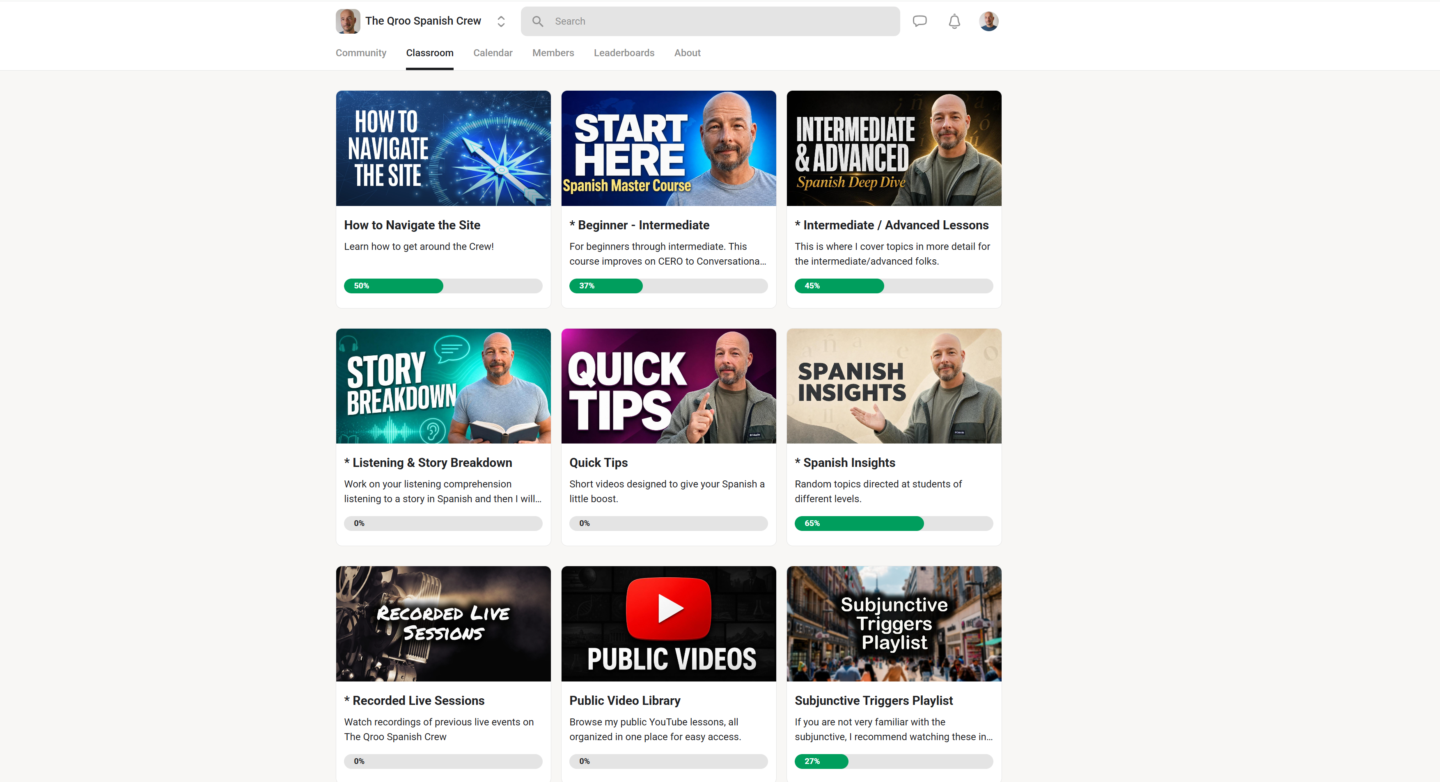
The Qroo Spanish Crew: How Qroo Paul Built an 8,200-Member Skool Community at $29 a Month

DY Salsa Dance Academy: How Diego Rivera Prices a 758-Member Skool Community at $49 a Month

Sweet Samantha Embroidery: Michelle Newsome on Skool